
Top Innovations in Modern Towel Manufacturing
In an era where textiles meet technology, towel manufacturing has witnessed rapid advancements reshaping both performance and sustainability. From antimicrobial fibers to smart textile towels that integrate drying sensors, cutting-edge processes and materials now deliver unprecedented levels of absorbency, softness, and durability. This comprehensive overview details the foremost innovations driving the industry—and how leading manufacturers, including Circe Towel, leverage these breakthroughs to provide superior towels for hospitality, gyms, spas, and everyday use.
Towel Manufacturing Technology: The Modern Landscape
Antimicrobial and Functional Fibers
With increasing demand for hygienic and skin-friendly towels, new fiber technologies are taking center stage. Antimicrobial yarns, such as silver-ion infused cotton or bamboo viscose blends, inhibit bacterial growth and odors without compromising softness. These fibers pass stringent tests for antimicrobial efficacy, ensuring compliance with OEKO-TEX STANDARD 100 and relevant AATCC standards.
Bamboo Viscose & Blends
Bamboo viscose delivers a silky handfeel, enhanced moisture management, and natural resistance to microbes. Blending bamboo with long-staple cotton creates towels that excel in absorbency and provide eco-friendly appeal. Such blends are ideal for baby towels, spa applications, and promotional programs seeking sustainable stories.
Fast-Dry Technologies
Innovative quick-dry solutions balance absorbency with convenience, ideal for hospitality and gyms. Microfiber towels, crafted using fine denier polyester and nylon, boast ultra-short drying times. Advanced weaving processes—such as low-twist or zero-twist terry and honeycomb structures—maximize surface area for moisture wicking and speed up evaporation. GSM selection is key: sports towels often use 180–300 GSM microfiber while luxe bath towels employ 450–700 GSM combed cotton.
- Low-twist combed cotton for plushness and rapid drying
- Honeycomb/waffle weave for lightweight airiness and faster moisture release
- Microfiber suede for ultra-fast gym towel performance
Smart Textile Towels: The Future is Connected
Smart textile towels incorporate embedded sensors or RFID tags for laundry tracking, wear monitoring, and even moisture detection. AI-powered weaving controls optimize loop height, density, and twist precision, mimicking artisan craftsmanship at scale.
AI Weaving and Quality Control
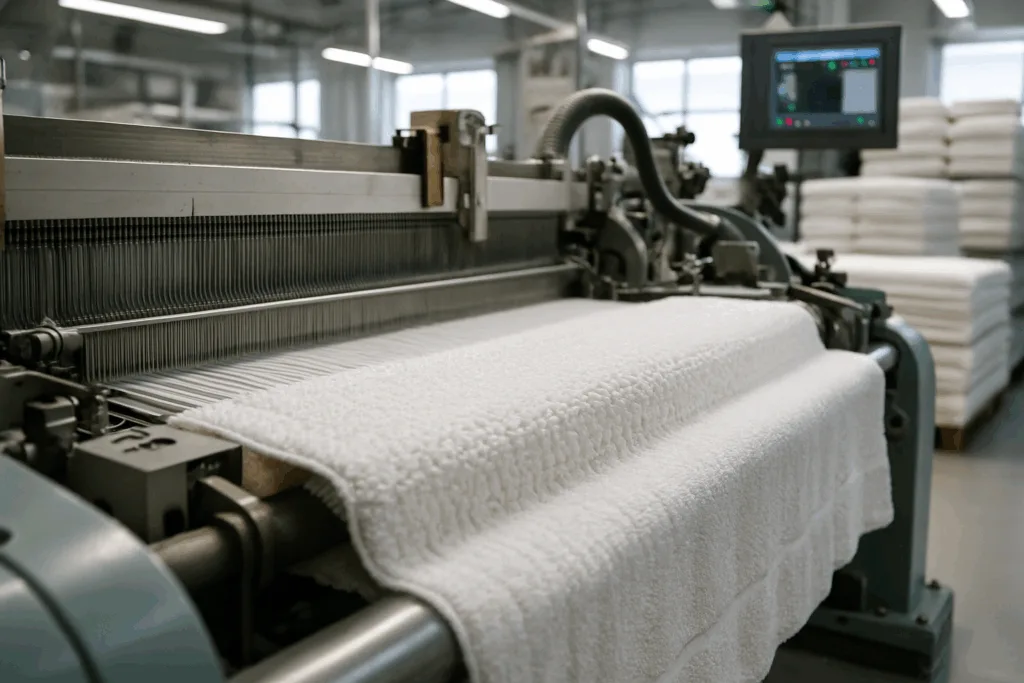
Modern weaving machines integrate AI vision systems to monitor terry loop formation and isolate defects such as skipped loops or lint clusters. Real-time data analysis enables immediate corrections, ensuring consistently high absorbency and durability in every production run. Circe Towel deploys these systems for both OEM and ODM clients, adding technical transparency and quality assurance.
Precision Spinning & Weaving Advances
Fiber Selection and Spinning Techniques
Long-staple combed cotton, Egyptian and Turkish cotton, and GOTS-certified organic variants offer longer fibers that resist pilling and improve handfeel. Ring-spun methods twist fibers for enhanced softness, while open-end spinning accelerates production for budget-centric ranges. Pile ratio and selvage control during loom setup directly impact loop density and the towel’s weighted luxury.
Popular Weave Constructions
- Terry loop (single/double) for classic absorbency
- Zero-twist: extra plush, less lint, greater softness
- Jacquard: intricate patterns, elevated branding
- Velour shearing: smooth hand, ideal for promotional beach towels
Lint Management and Pile Pull Resistance
Lint shedding is minimized through tight loop formation, effective finishing, and vertical wicking checks (AATCC 197). Pile pull resistance ensures longevity even after hundreds of industrial washes—a key metric for hotels and spas prioritizing cost-per-use.
Dyeing, Printing & Colorfastness Breakthroughs
Advanced Dyeing Methods
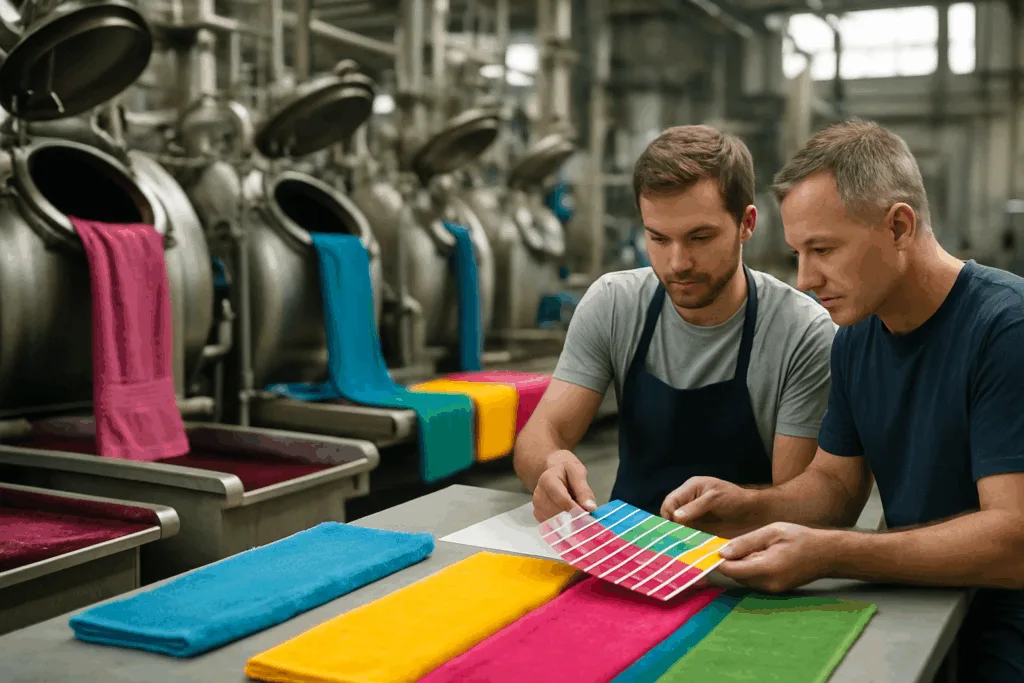
Reactive and vat dyeing allow deep penetration in cotton fibers, yielding vibrant colors with outstanding wash and chlorine resistance (AATCC 61/8/162). Yarn-dye techniques produce sharp stripes and risk-free jacquards, while piece-dye remains cost-efficient for solid OEM runs.
Digital & Sublimation Printing
Beach and sports towels benefit from high-resolution digital prints and sublimation imaging—particularly for microfiber products. These processes provide unlimited design flexibility with rapid iteration and bulk color approval adhering to buyer specs.
Color Approval and Bulk Shade Control
Modern dye labs use spectrophotometry and bulk shade panels to hit Pantone targets reliably, reducing disputes and sample cycles. Circe Towel’s color approval protocol ensures repeatable results even on complicated blended yarns.
Finishing Innovations for Performance & Feel
Softening and Conditioning
- Enzyme washes strip impurities for superior tactile softness
- Low-VOC silicone finishes add anti-pilling and silky touch
- Steam/tumble conditioning stabilizes final dimensions and reduces shrinkage
Functional Additives
Antimicrobial treatments, pre-shrink compaction, and advanced anti-pilling coatings are now standard options, especially for luxury hospitality and fitness towels. Non-marketed, generic chemicals meet Prop 65 and REACH guidelines, protecting consumers and operators alike.
Quality Assurance & Testing
Standardized Benchmarks
Industry leaders apply rigorous laboratory tests to every production batch:
- Absorbency: AATCC 79
- Vertical wicking: AATCC 197
- Colorfastness: AATCC 61/8/162
- Pilling: ASTM D3512/ISO 12945
- Snagging: ASTM D3939
- Tensile/seam strength: ASTM D1683/D5034
These tests validate every towel’s performance for absorbency, durability, and color retention, and ultimately influence buyer confidence.
Compliance and Sustainability
Modern factories, including Circe Towel’s operations, maintain OEKO-TEX STANDARD 100 certification and pass BSCI, WRAP, or SEDEX audits. Water and chemical management, along with bulk waste minimization, uphold environmental stewardship, a growing priority for B2B buyers in hospitality and retail.
Size, Application, and Customization Trends
Versatility by Size & Use
| Fiber/Weave | GSM Range | Absorbency | Dry Time | Best Use |
|---|---|---|---|---|
| Long-staple cotton terry | 450–700 | High | Moderate | Bath, hotel, spa |
| Bamboo/cotton blend terry | 400–600 | Very high | Fast | Baby, eco-friendly, spa |
| Microfiber suede | 180–300 | Moderate | Very fast | Sports, travel, gym |
| Zero-twist cotton velour | 500–900 | High | Moderate | Promotional, beach |
Customization & Branding
OEM clients benefit from a spectrum of personalization: custom embroidery, digital printing, jacquard borders, and specialized hanger loops. Packaging choices span ribbon wraps, sleeves, compostable bags, and retail-ready carton specs. Bulk sampling workflows—PP samples, TOP, and mass production—ensure visual and tactile alignment to buyer briefs.
Expert takeaway: “Selecting the right fiber and weave determines the balance of absorbency, handfeel, colorfastness, and cost. Smart manufacturing lets buyers match performance precisely to segment—from eco-conscious spas to high-volume hotels.”
Pioneering Smart Towel Manufacturing: AI, Automation, and Data
AI Loom Control and Predictive Analytics
High-speed weaving looms, equipped with AI-driven defect prediction, produce thousands of meters per day with unmatched consistency. Predictive analytics anticipate machine downtime, optimize energy usage, and cut waste, lowering total cost of ownership for bulk buyers.
Embedded RFID and Sensor Integration
RFID-embedded towels simplify laundry logistics; sensors can relay real-time moisture and usage data, ideal for smart hotels or fitness centers. These innovations streamline asset tracking and yield operational cost savings.
Packaging, Logistics & B2B Service
Modern Packaging Solutions
- Belly bands, ribbon wraps, and eco polybags
- Vacuum-packing for large volumes
- Retail-ready cartons for branding impact
Global Logistics: Incoterms Explained
Bulk towel shipments flow via EXW/FOB/CIF/DDP terms, tailored for each market and regulatory landscape. Sampling workflows, parallel pilot production, and top-of-production (TOP) control give buyers hands-on assurance and flexibility.
Choosing a Towel Manufacturing Partner
Assessing Technological Edge
Buyers seeking innovation should ask about the factory’s fiber library, dye lab capabilities, AI weaving technologies, and sustainability credentials. Circe Towel’s multifiber expertise—including Egyptian, Turkish, bamboo, microfiber, and organic blends—plus rigorous bulk testing and B2B service, provide security for brands demanding performance and reliability.
Buyer Outcomes & Next Steps
- Define primary use case: luxury, sport, baby, promotional
- Select fiber/weave to match desired absorbency, drying speed, softness, and budget
- Request compliance certificates and performance tests
- Choose branding, packaging, and shipment terms
- Confirm OEM/ODM sample process before bulk commitment
For partners prioritizing technical excellence and reliability, Circe Towel’s technology-forward solutions integrate the latest industry innovations with attentive B2B service—tailored to every towel segment.
Frequently Asked Questions
What fibers are best for antimicrobial towels?
Bamboo viscose and silver-ion infused cotton are widely used for antimicrobial towels due to their natural resistance to microbes and skin-friendly properties.
How do GSM and weave influence towel performance?
Higher GSM and loop density enhance absorbency and plushness; weaves like honeycomb or zero-twist improve drying speed and softness for different applications.
What smart towel features are available?
Key smart features include embedded RFID tags for asset tracking and sensors for moisture monitoring, optimizing logistics in hotels and gyms.
How is colorfastness ensured in high-quality towels?
Reactive and vat dyeing methods, combined with strict bulk shade control and standard lab tests, maintain color vibrancy and resistance to washing and chlorine.
What certifications should buyers look for in towels?
OEKO-TEX STANDARD 100, GOTS for organic, and BSCI/WRAP/SEDEX audits guarantee safety, quality, and ethical production practices.
What’s the most important factor when choosing towel manufacturing technology?
Fiber type, weaving technology, and testing standards jointly impact absorbency, softness, durability, and long-term buyer satisfaction.