
For Amazon sellers, towels look like an easy product at first. They are familiar, practical, repeat-purchase friendly, and suitable for many markets: bath, beach, gym, yoga, pets, baby care, hotel supplies, spa gift sets, and home essentials. But once a towel moves from “factory sample” to “Amazon-ready inventory,” the project becomes much more than fabric, GSM, and color.
A successful Amazon towel order depends on three things working together: product quality, retail-ready packaging, and FBA preparation. A towel can be soft, absorbent, and beautifully finished, but if the barcode is wrong, the polybag does not meet prep requirements, the cartons are mixed, or the seller’s SKU information is not followed, the inventory may be delayed before it ever reaches the customer.
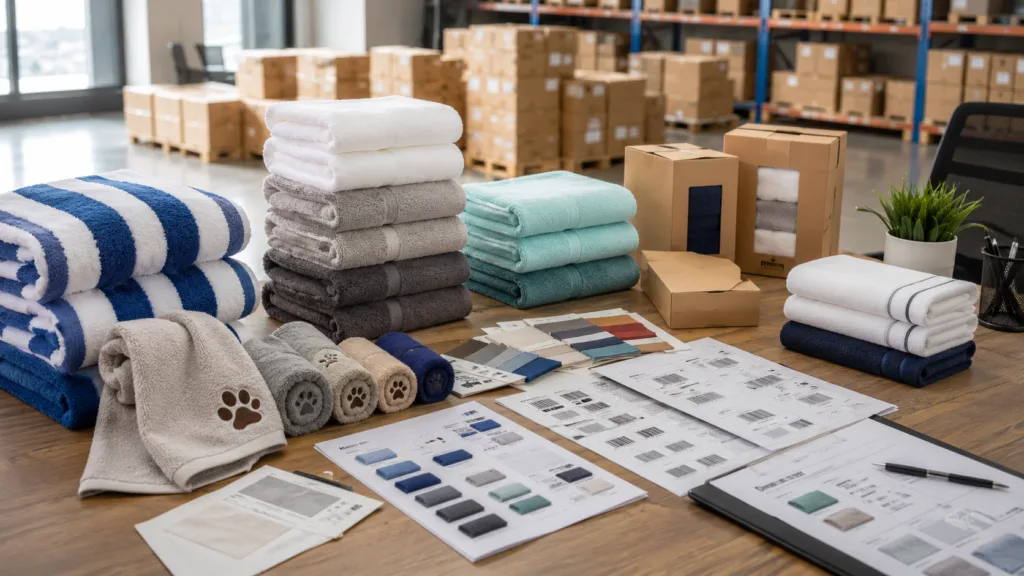
This is why experienced Amazon sellers do not only ask, “What is your towel price?” They ask better questions:
Can each unit be packed individually?
Can you apply FNSKU labels?
Can you separate colors by SKU?
Can you prepare carton marks and packing lists?
Can you control size, GSM, color, stitching, lint, and packaging consistency?
Can you help reduce FBA prep mistakes before shipment?
This guide is written for Amazon sellers, private label brands, importers, wholesalers, hotel buyers, and retail-channel buyers who source towels in bulk and need a supplier that understands both production and marketplace delivery.
Why Amazon Sellers Need More Than a Towel Supplier
A traditional towel supplier may focus on material, weaving, dyeing, embroidery, and packing into export cartons. That is important, but Amazon sellers need one more layer: retail execution.
Amazon inventory is not handled like general wholesale cargo. Each unit must be identifiable. Each sellable pack must match the listing. Each barcode must correspond to the correct SKU. Each carton must be prepared according to the shipment plan. If one bath towel set is mislabeled as another color, or if one carton contains a mixed assortment that is not declared correctly, receiving problems can follow.
For mature Amazon sellers, the supplier’s job is not only to produce towels. The supplier should help turn a product idea into repeatable inventory.
That means confirming the towel specification, packaging structure, unit label position, SKU separation, carton quantity, carton dimensions, gross weight, and shipping documents before bulk production leaves the factory.
For a small test order, a seller may tolerate some manual prep after arrival. But for large orders, this becomes expensive. A few hundred units can be relabeled by hand. Several thousand units with wrong labels can become a warehouse problem. Ten thousand units with poor carton separation can become a serious cash-flow issue.
This is why Amazon towel sellers should choose a supplier that understands both textile manufacturing and FBA-oriented packing.
Common Towel Products Sold by Amazon Sellers
Towels are flexible products for Amazon because they can serve many niches. The most common towel categories include:
- Bath towels
- Hand towels
- Face towels
- Washcloths
- Beach towels
- Gym towels
- Yoga towels
- Pet towels
- Hair towels
- Baby hooded towels
- Kitchen towels
- Spa towels
- Hotel-style towel sets
- Travel and camping towels
Each towel category has a different sourcing logic.
A bath towel set may be sold as a 2-piece, 4-piece, 6-piece, or 8-piece set. A beach towel is often sold as a large single unit with attractive design and retail packaging. A pet towel may need a hang tag, belly band, or compact polybag for easy storage. A yoga towel may require anti-slip dots, microfiber fabric, and individual retail packaging. A hotel towel order may focus more on GSM, whiteness, durability, and washing performance than decorative packaging.
For Amazon sellers, the key question is not only “Can the factory make this towel?” The better question is: “Can the factory make this towel in a way that matches our Amazon listing, packaging plan, and fulfillment requirements?”
Packaging Options for Amazon Towel Sellers
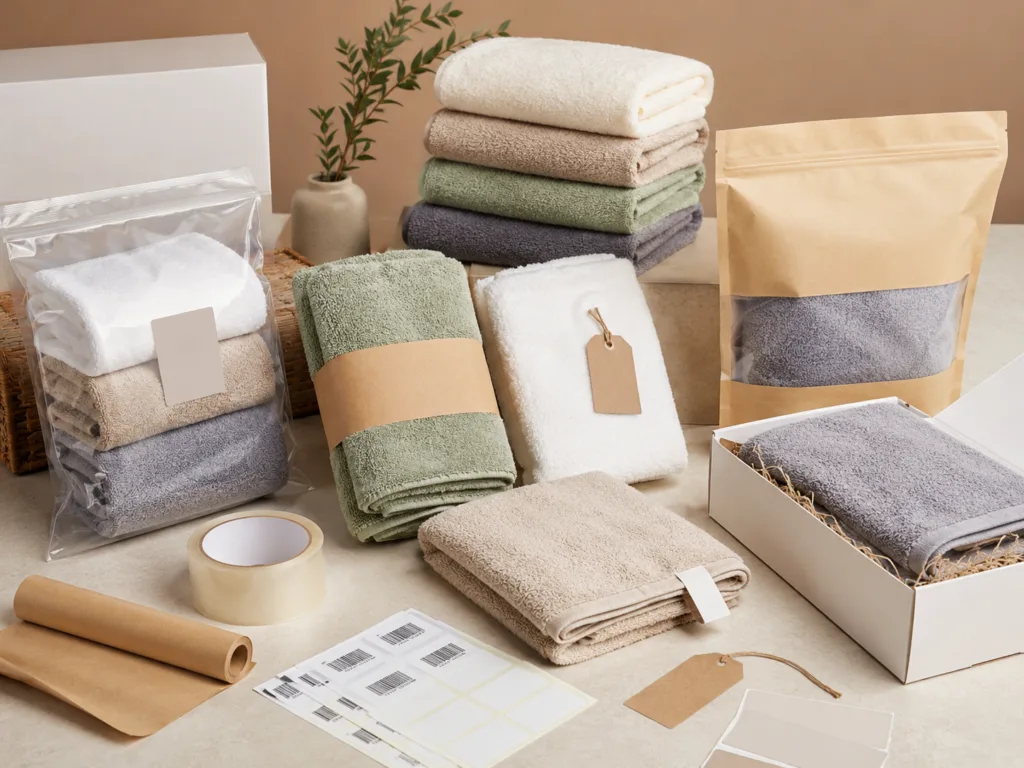
Packaging is one of the most important decisions in a towel sourcing project. It affects product protection, brand positioning, shipping volume, FBA prep, customer experience, and retail value.
1. Individual Polybag Packaging
Individual polybag packaging is one of the most common options for Amazon towel sellers. It protects each towel from dust, moisture, handling marks, and carton contamination during transport.
For FBA, polybag packaging should be discussed carefully before production. The bag should be properly sealed. The product barcode or FNSKU should be scannable through the bag or placed on the outside. If the bag opening is large enough to require a suffocation warning under Amazon’s requirements, the warning should be printed on the bag or applied as a label.
Polybag packaging is practical for bath towels, hand towels, pet towels, gym towels, microfiber towels, and multi-color SKU orders. It is also useful when each color or size needs to be treated as a separate sellable unit.
2. Belly Band Packaging
Belly bands are popular for private label towels because they give a clean retail look without the cost of a full box. A kraft paper belly band, printed paper sleeve, or recyclable card band can show the brand name, towel size, material, care notes, and barcode.
This is a good option for Amazon sellers who want a more eco-conscious image or a soft lifestyle presentation. It works especially well for bath towels, spa towels, hand towel sets, baby towels, and gift-oriented products.
However, a belly band alone may not fully protect the towel during FBA handling. Many sellers choose belly band plus clear polybag, so the product has both branding and protection.
3. Hang Tag and Woven Label
Hang tags and woven labels are useful for brand building. A hang tag can show product benefits, care instructions, material claims, brand story, or QR code. A woven label can carry the brand name permanently on the towel.
For Amazon sellers, these small branding details matter because the customer cannot touch the towel before buying. The listing photo, packaging, and first unboxing experience must build trust.
A supplier can usually support custom woven labels, printed labels, embroidery labels, hang tags, and care labels. But the seller should confirm all legal label information for the target market, especially fiber content, country of origin, and responsible company information.
4. Retail Box or Gift Box
Retail boxes are suitable for towel gift sets, baby towel sets, spa towel sets, premium bath towel bundles, and seasonal gift products.
A box improves perceived value and makes the product easier to position as a gift. It also protects the towel shape better than loose packing. For Amazon sellers competing in higher price ranges, packaging can help justify a stronger retail price.
The trade-off is cost and shipping volume. Gift boxes increase carton space, which may raise sea freight, air freight, storage, and FBA fees. Before choosing a box, sellers should ask for unit dimensions, carton dimensions, units per carton, gross weight, and estimated CBM.
5. Vacuum Packing
Vacuum packing can reduce volume for bulky towels. It may be useful for large bath towels, beach towels, blankets, or towel sets.
But sellers should test it before using it for bulk orders. Some towels may need time to recover their softness and volume after compression. If the customer opens the package and the towel looks flat or tired, the product may receive poor reviews even if the fabric quality is good.
For Amazon products, packaging should not only reduce cost. It should protect the customer experience.
MOQ: What Amazon Sellers Should Know Before Ordering Towels
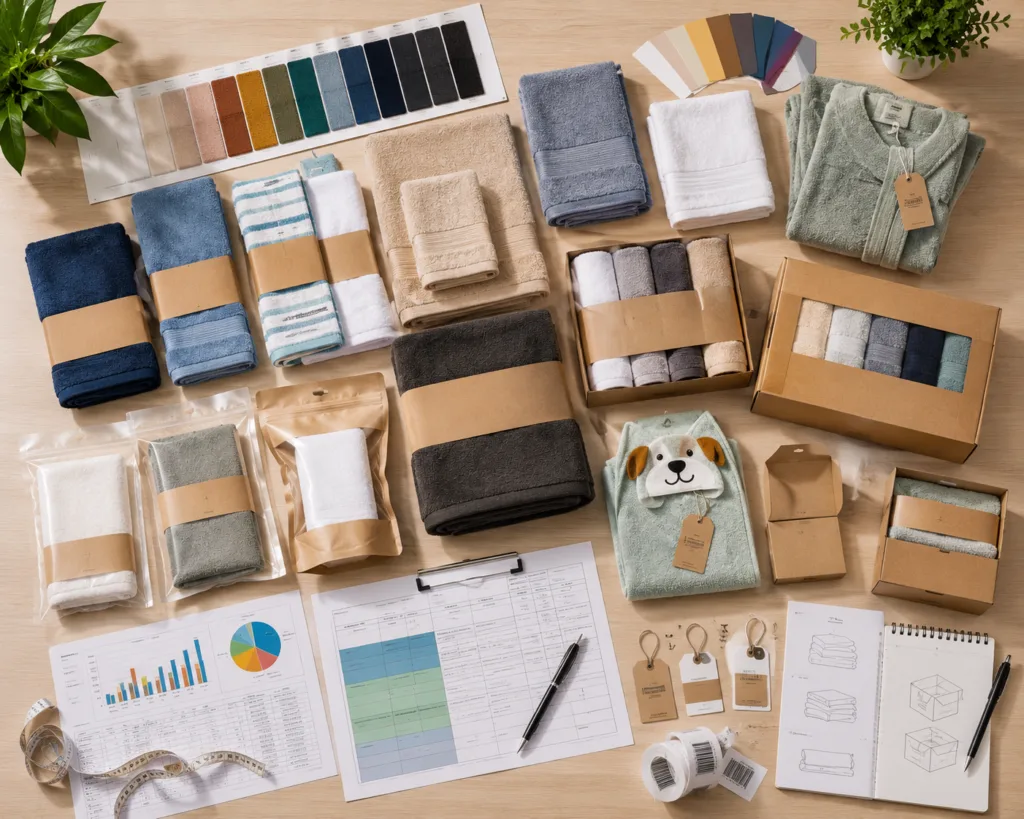
MOQ is one of the most misunderstood topics in towel sourcing. Many sellers ask for a low MOQ, but the real MOQ depends on how much customization is required.
A simple order using existing towel size, existing color, and simple packaging may allow a lower MOQ. A fully customized towel with special GSM, custom color, woven logo, embroidery, printed packaging, and multiple SKUs will require a higher MOQ.
In towel manufacturing, MOQ can be affected by:
- Yarn and material availability
- Towel size
- GSM and weight
- Dyeing color
- Fabric structure
- Logo method
- Packaging type
- Number of colors
- Number of SKUs
- Carton separation requirements
- Whether the product is stock-based or custom-made
For Amazon sellers, the best strategy is usually to start focused. Instead of launching ten colors at once, choose one or two strong colors. Instead of developing five towel sizes, begin with the best-selling size. Instead of requesting luxury packaging immediately, test a clean and practical packaging structure first.
Once sales data is clear, the seller can expand into more colors, bundles, gift sets, and upgraded packaging.
For mature buyers, MOQ should not be seen only as a barrier. It is also a production control tool. When quantity is too small, the supplier may not be able to control dyeing consistency, packaging cost, or custom material sourcing efficiently. A realistic MOQ helps both sides build a stable product line.
Barcode, UPC, GTIN, ASIN and FNSKU: What Amazon Sellers Must Understand
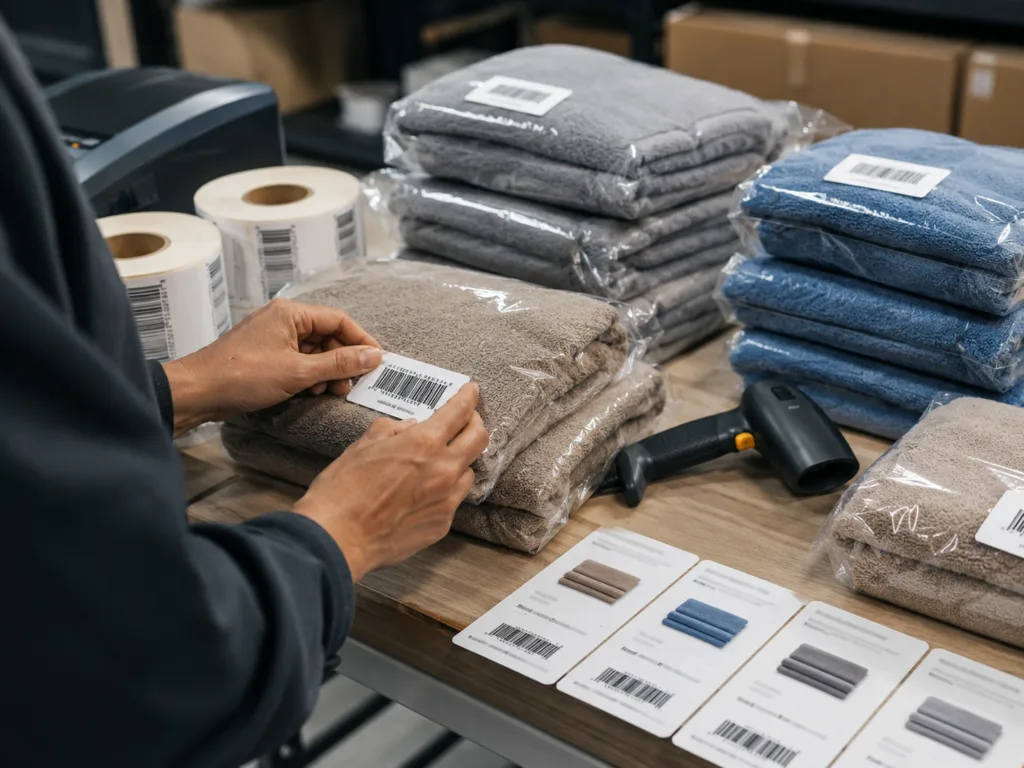
Barcode confusion is one of the most common problems in Amazon sourcing. Sellers often use UPC, GTIN, ASIN, and FNSKU interchangeably, but they are not the same.
A UPC is the barcode format commonly used in North America. The number behind it is a GTIN, which identifies a product globally. GS1 is the recognized standards organization for issuing GTINs. For sellers planning to grow beyond Amazon into retail, wholesale, or multi-marketplace channels, GS1-based product identification is usually the safer long-term option.
An ASIN is Amazon’s own product identifier. Amazon assigns it after a product is listed or matched to an existing listing.
An FNSKU is Amazon’s fulfillment network SKU. It is used to identify inventory within Amazon’s fulfillment system, often linking inventory to a specific seller.
For Amazon FBA towel orders, the key question is: should the unit carry the manufacturer barcode or an Amazon barcode?
This decision should be confirmed inside the seller’s Amazon Seller Central account before bulk production. A supplier should not randomly create barcodes for the seller. The seller should provide confirmed UPC/GTIN information, Amazon barcode files, FNSKU labels, or packaging artwork based on the listing and fulfillment setup.
Circe Towel can help apply barcode labels, print approved barcode artwork, separate SKUs, and check label placement before shipment. But the seller should verify the barcode type, label file, and Amazon shipment requirements before mass production.
This is not only a compliance detail. It is inventory protection. If the wrong barcode is printed on 5,000 towel sets, the mistake is much harder to fix than changing a carton mark.
FBA Prep for Towels: What a Supplier Can Help With
A reliable towel supplier can help Amazon sellers reduce prep work before goods leave the factory. This is especially valuable for sellers shipping directly to Amazon warehouses, overseas warehouses, 3PL prep centers, or retail distribution centers.
For towel orders, FBA-oriented prep may include:
- Individual polybag packing
- Belly band packaging
- Hang tag attachment
- Woven label or care label sewing
- FNSKU or barcode label application
- SKU-based color separation
- Inner carton and master carton packing
- Carton mark printing
- Packing list preparation
- Carton dimension and weight confirmation
- Product and packaging photo confirmation
- Barcode scan checking
- Pre-shipment inspection
- Support for shipping to freight forwarder, overseas warehouse, or Amazon FBA destination
For Amazon sellers, the most important thing is repeatability. The first order sets the standard. The second and third orders must follow the same approved sample, same packaging layout, same barcode position, and same carton logic.
A supplier that treats every reorder as a fresh project creates risk. A supplier that keeps records of approved samples, packaging files, labels, carton quantities, and SKU instructions becomes a long-term partner.
Carton Packing and Shipping Considerations
Towels are soft goods, but they are not always cheap to ship. They take volume, especially bath towels, beach towels, and towel sets. A low unit price can be misleading if the packing method creates high CBM or inefficient carton loading.
Before placing a bulk order, Amazon sellers should ask for:
- Unit packed size
- Units per carton
- Carton size
- Gross weight
- Net weight
- Total cartons
- Total CBM
- Carton mark details
- Whether SKUs are mixed or separated by carton
For FBA shipments, carton accuracy is critical. Each carton must match the shipment plan. If a carton label is missing, damaged, or placed incorrectly, receiving delays may happen. If box content information is wrong, Amazon may have trouble processing the shipment accurately.
For towel suppliers, carton packing is also a quality-control issue. Towels should be packed tightly enough to protect shape and control volume, but not so tightly that the product becomes crushed. White towels should be protected from dust and carton rub. Dark towels should be checked for lint transfer. Mixed-color sets should be separated carefully to avoid color contamination.
Large Amazon sellers often care deeply about carton stability because they are not shipping one sample box. They are moving repeat inventory through an international supply chain.
Quality Control Points for Amazon Towel Orders
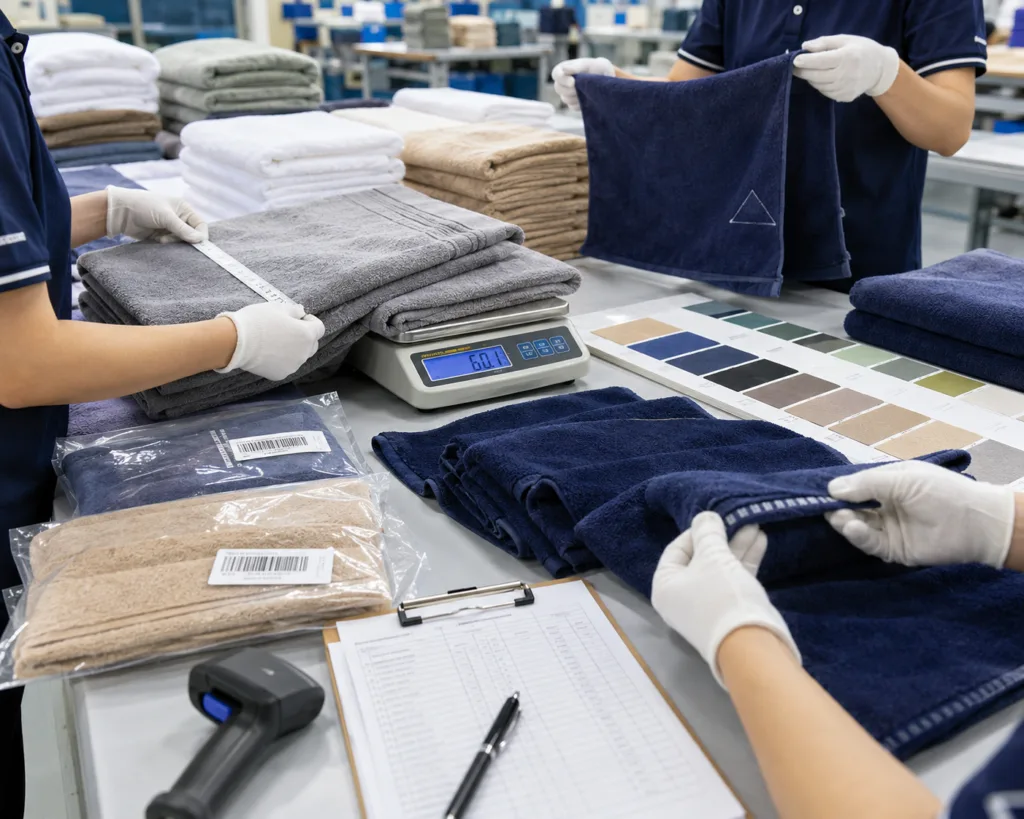
Amazon customers judge towels quickly. They care about softness, absorbency, lint, color, thickness, smell, stitching, shrinkage, and whether the product matches the listing photos.
For B2B buyers, quality control should begin before mass production. The approved sample should become the production standard.
Key QC points include:
- Size tolerance
- GSM and weight
- Material composition
- Color consistency
- Edge stitching
- Logo position
- Embroidery quality
- Printing clarity
- Woven label accuracy
- Care label information
- Absorbency
- Lint control
- Odor check
- Shrinkage after washing
- Packaging accuracy
- Barcode scan test
- Carton quantity check
For Amazon sellers, packaging QC is just as important as towel QC. One wrong label or mixed carton can create more operational trouble than a small fabric defect.
Circe Towel can help check approved samples, confirm packaging before bulk production, take production photos when needed, and inspect finished goods according to the buyer’s specification. For mature buyers, we recommend confirming a pre-production sample before bulk production and locking the packaging standard at the same time.
Textile Labeling and Retail Compliance
Amazon rules are only one part of the picture. Towels sold in the United States, Europe, Australia, or other retail markets may also require product labeling information.
For the U.S. market, textile products generally need correct fiber content, country of origin, and the identity of the responsible company, manufacturer, importer, distributor, or retailer. Care instructions are also important for customer satisfaction and retail compliance.
For Amazon sellers, this means the care label should not be treated as decoration. It should be planned before production. A towel label may need to show:
- Fiber content
- Country of origin
- Washing instructions
- Brand name or responsible company information
- Size or product code
- Batch reference if required by the buyer
Circe Towel can produce sewn labels, woven labels, printed care labels, hang tags, and packaging inserts based on the buyer’s confirmed content. However, the final legal wording should be confirmed by the buyer according to the target market.
How Circe Towel Supports Amazon and Retail Buyers
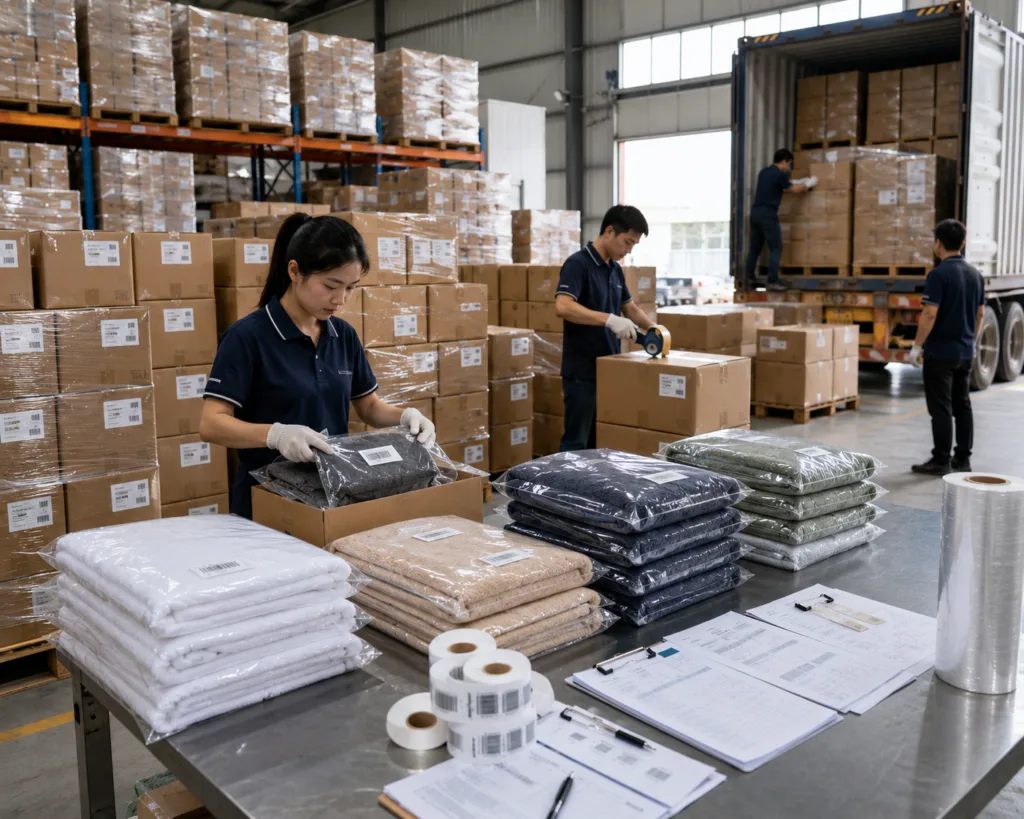
Circe Towel works with buyers who need more than a simple bulk towel order. Our role is to help Amazon sellers, brands, wholesalers, importers, hotels, and retail-channel buyers turn towel ideas into production-ready and shipment-ready orders.
We can support:
- Custom towel size, GSM, material, and color
- Cotton, microfiber, bamboo blend, and other towel options
- Bath towels, beach towels, pet towels, gym towels, yoga towels, baby towels, and hotel towels
- Embroidery, woven label, printed logo, and private label development
- Retail packaging, polybag packing, belly band, gift box, hang tag, and carton packing
- Barcode and FNSKU label application based on buyer-provided files
- SKU-based packing and color separation
- Pre-production sample confirmation
- Bulk production quality control
- Export carton preparation
- Shipment support to freight forwarder, overseas warehouse, or Amazon-related logistics route
We are especially suitable for buyers who want to build a repeatable towel product line instead of placing a one-time low-price order. For Amazon sellers, this matters because long-term success depends on stable quality, stable packaging, and stable inventory preparation.
Best Ordering Process for Amazon Towel Sellers
A professional towel order should follow a clear process.
Step 1: Confirm the Product Type
Start with the towel category: bath towel, beach towel, pet towel, gym towel, yoga towel, baby towel, hand towel, or towel set.
Step 2: Confirm Size, GSM and Material
The seller should confirm target size, thickness, absorbency, softness, and price level. A 400 GSM towel and a 600 GSM towel may target completely different customers.
Step 3: Decide the Logo Method
Logo options may include embroidery, woven label, printed label, jacquard, sublimation, or heat transfer depending on towel type and material.
Step 4: Choose the Packaging Structure
Confirm whether the product will use polybag, belly band, hang tag, gift box, vacuum packing, or a combination.
Step 5: Confirm Barcode and Label Files
The seller should provide approved UPC, FNSKU, Amazon barcode file, carton label requirement, and packaging artwork before bulk production.
Step 6: Approve the Sample
The sample should confirm towel quality, packaging layout, label position, and barcode placement. Do not approve only the towel and leave packaging for later.
Step 7: Lock Bulk Production Standard
Once the sample is approved, the supplier should follow the confirmed material, size, color, logo, packaging, and carton instructions.
Step 8: Check Before Shipment
Before shipment, confirm carton quantity, carton size, gross weight, packing list, SKU separation, and product photos if required.
Final Thoughts: A Good Towel Supplier Helps Sellers Avoid Expensive Mistakes
For Amazon sellers, towels are a strong category because they are practical, visual, and suitable for private label development. But the real profit is not only in finding a low unit price. It is in building a product that can move smoothly from factory to listing, from carton to warehouse, and from warehouse to customer.
Packaging, MOQ, barcode, and FBA prep are not small details. They shape the seller’s cost, launch speed, review quality, and reorder confidence.
A mature towel buyer should look for a supplier that understands production, packaging, labeling, SKU control, and export packing. That is where Circe Towel can help.
If you are developing towels for Amazon, retail, hotel supply, wholesale distribution, or private label channels, start with the full picture: product specification, packaging plan, barcode responsibility, MOQ structure, and shipment preparation. The earlier these details are confirmed, the fewer problems appear after production.
FAQ
1. Can Circe Towel apply FNSKU labels for Amazon towel orders?
Yes. Circe Towel can apply FNSKU or barcode labels based on the files provided by the buyer. The seller should first confirm the correct barcode type and label file inside Amazon Seller Central before bulk production.
2. What is the MOQ for private label towels?
MOQ depends on towel size, material, GSM, color, logo method, packaging type, and SKU quantity. Existing towel options with simple packaging usually allow a lower MOQ, while custom colors, custom weaving, gift boxes, and multiple SKUs require higher MOQ.
3. Can towels be individually packed for Amazon FBA?
Yes. Towels can be packed individually in polybags, belly bands, retail boxes, or other packaging styles. For FBA-oriented orders, packaging should protect the towel, keep the unit clean, and allow the barcode to be scanned properly.
4. What information should Amazon sellers prepare before requesting a quotation?
Sellers should prepare towel type, size, GSM, material, color, logo method, packaging style, target quantity, SKU list, barcode requirements, and shipping destination. Clear information helps the supplier quote accurately and avoid production mistakes.