
For yoga studios, Pilates clubs, boutique gyms and wellness brands, a towel is no longer just a towel. It is part of the client experience, part of the brand presentation and, in many cases, part of the retail profit model. A well-made non-slip yoga or Pilates towel can improve grip, absorb sweat, protect shared equipment, support hygiene standards and create a more professional branded environment.
This is especially important for hot yoga studios, reformer Pilates classes, barre studios, fitness clubs, wellness resorts, spa gyms, sports retailers and private label lifestyle brands. These buyers are not simply looking for a soft towel. They need a product that performs under repeated use, survives commercial washing, looks good in a retail display and can be produced consistently in bulk.
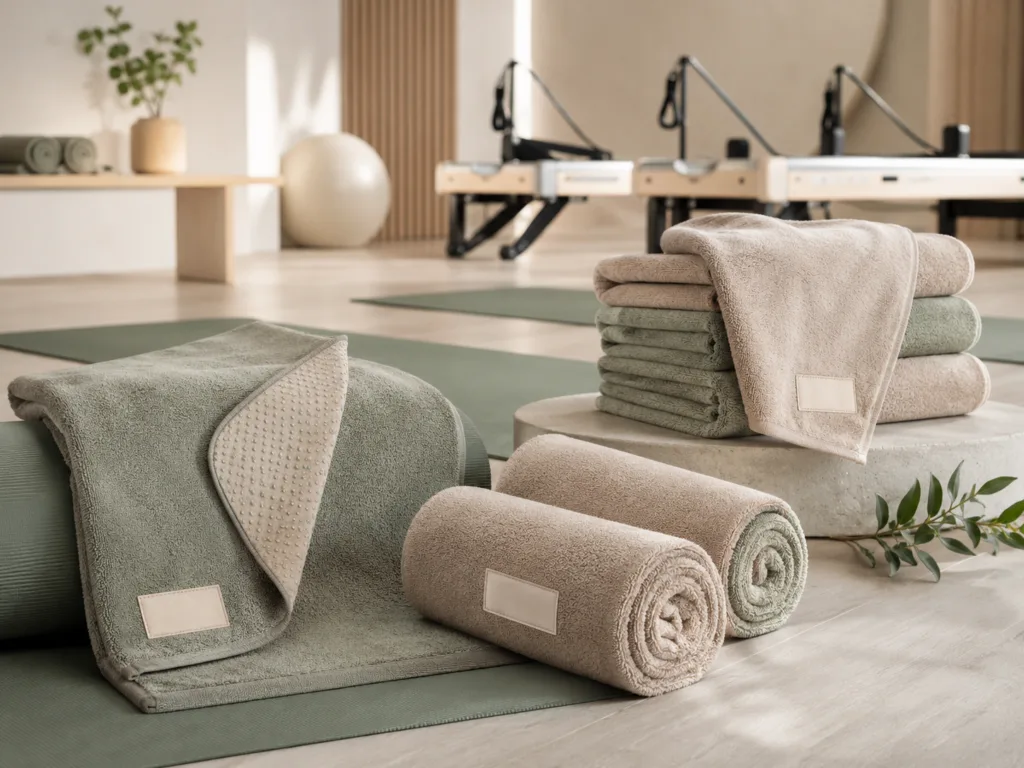
For mature buyers, the key questions are practical: What fabric should I choose? What GSM is suitable? What size works for yoga mats or Pilates reformers? Should I use stock fabric with light customization or develop a fully custom towel from scratch? What MOQ should I expect? How much should sample development cost? What packaging makes sense for wholesale, retail or studio use?
This guide breaks down the most important product and sourcing details behind custom non-slip yoga and Pilates towels, so studios, gyms, wellness brands and importers can make a more confident purchasing decision before placing a bulk order.
Why Non-Slip Yoga and Pilates Towels Are Becoming a Strong B2B Product
Yoga, Pilates and wellness training have moved far beyond niche fitness. In many markets, especially North America, Europe and Australia, studios and gyms compete not only on class quality but also on the overall member experience. Clean equipment, consistent branding, thoughtful accessories and retail-ready products all influence how premium a brand feels.
A non-slip towel fits naturally into this trend. It is practical, easy to understand and frequently used. Compared with bulky fitness equipment, towels are easier to ship, easier to store and easier to customize. For a yoga studio or Pilates club, they can be used as rental towels, member gifts, class accessories or branded merchandise. For retailers and importers, they can be developed into color collections, gift sets or private label fitness products.
The product also solves several real user problems:
- Sweat makes mats and equipment slippery.
- Shared studio equipment needs a cleaner contact layer.
- Ordinary towels shift during movement.
- Low-quality towels lose shape after washing.
- Generic accessories weaken brand presentation.
A good non-slip yoga or Pilates towel should make practice safer, cleaner and more comfortable while giving the buyer a product that can be sold, gifted or used repeatedly.
Fabric Options: Microfiber, Suede Microfiber, Cotton Blend and More
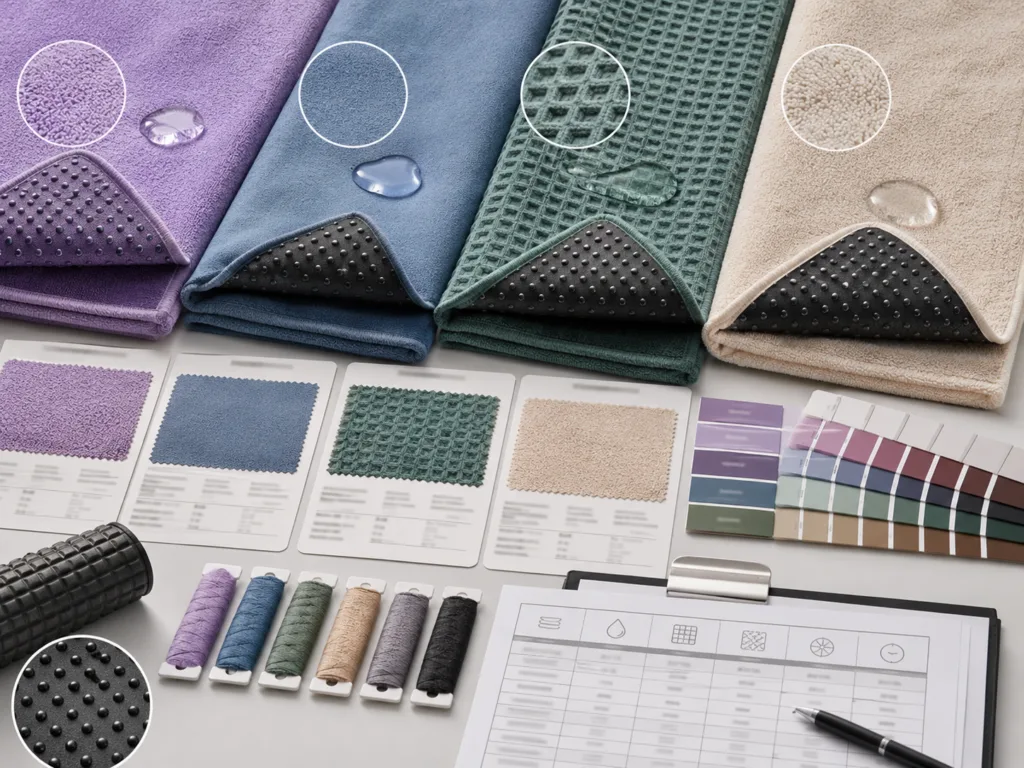
Fabric selection is one of the most important decisions when developing custom non-slip yoga and Pilates towels. Different fabrics create different handfeel, absorbency, drying speed, print effect and price points.
Microfiber
Microfiber is one of the most common materials for yoga towels and fitness towels. It is usually made from polyester and polyamide blends. The main advantages are high absorbency, quick drying, lightweight structure and good print performance.
For yoga and Pilates use, microfiber works well because it can absorb sweat without becoming too heavy. It also folds compactly, which is useful for retail packaging, studio storage and travel-friendly fitness products.
Microfiber is suitable for:
- Hot yoga towels
- Pilates reformer towels
- Gym towels
- Travel fitness towels
- Printed private label towels
- Retail towel collections
Suede Microfiber
Suede microfiber has a smoother, more premium surface. It is often used for yoga mat towels because it feels soft against the skin and allows full-surface digital printing. The surface is less fluffy than standard terry microfiber, which gives it a cleaner visual effect.
This fabric is especially suitable for brands that care about design, color gradients, patterns, seasonal collections and lifestyle positioning. If the buyer wants a towel that looks more like a premium wellness product than a basic gym item, suede microfiber is often a good choice.
Waffle Microfiber
Waffle microfiber has a textured structure that improves surface area and can help with moisture absorption. It creates a more technical and sporty appearance. For gyms, Pilates studios and fitness brands, waffle texture can make the product feel more performance-oriented.
Cotton Blend
Cotton blend towels feel more natural and familiar. They may be chosen by wellness brands, spas, hotels or studios that prefer a softer, more traditional towel touch. However, cotton is generally slower to dry than microfiber and may become heavier when wet.
Cotton blend is suitable when the brand wants:
- A more natural handfeel
- Spa-style presentation
- Softer skin contact
- A less synthetic product story
For high-sweat yoga and Pilates applications, microfiber or microfiber blend is usually more practical.
GSM: How to Choose the Right Weight for Performance and Cost
GSM means grams per square meter. It tells buyers how heavy and dense the towel fabric is. For yoga and Pilates towels, GSM affects absorbency, thickness, drying speed, packing volume, shipping weight and perceived quality.
There is no single “best” GSM for every order. The right choice depends on the product use and target price.
200–250 GSM
This range is lightweight and cost-efficient. It is suitable for promotional towels, travel towels, entry-level fitness towels and low-MOQ studio merchandise. The towel is easier to pack and ship, but it may feel thinner.
Best for:
- Promotional gifts
- Budget retail products
- Lightweight travel fitness towels
- Large-volume campaigns
260–300 GSM
This is a balanced range for many yoga and Pilates towels. It offers better absorbency and a more reliable handfeel while keeping the towel manageable for washing, packing and shipping.
Best for:
- Studio-branded yoga towels
- Pilates towels for regular classes
- Gym retail products
- Mid-range private label orders
320–380 GSM
This range feels more premium and absorbent. It is suitable for higher-end studios, wellness brands, gift sets and retail collections. The towel feels richer, but the buyer should consider higher fabric cost, higher freight weight and longer drying time.
Best for:
- Premium yoga studios
- Wellness resorts
- Gift packaging
- Retail-ready private label collections
Above 400 GSM
Very heavy towels may feel luxurious, but they are not always the best choice for yoga or Pilates. For active use, the towel must dry quickly and stay stable. If the towel becomes too thick or heavy, it may affect portability and washing efficiency.
For most bulk yoga and Pilates towel projects, 260–350 GSM is a practical range to evaluate first.
Anti-Slip Backing: Silicone Dots, Silicone Patterns and Grip Design
The anti-slip backing is what separates a true yoga or Pilates towel from an ordinary towel. Without the right grip structure, the towel may move during practice, especially when used on a yoga mat, reformer carriage, Pilates bench or studio floor.
Silicone Dot Backing
Silicone dots are one of the most popular options. They provide grip without making the towel too stiff. Dot size, spacing and distribution can be adjusted depending on the intended use.
Advantages:
- Good grip performance
- Flexible and foldable
- Suitable for yoga mats and Pilates equipment
- Cost-effective for bulk production
Silicone Pattern Backing
Instead of small dots, some buyers prefer larger patterns such as waves, lines, geometric shapes or brand-inspired grip designs. This can make the towel look more distinctive, but customized silicone patterns usually require higher setup costs and higher MOQ.
Advantages:
- More unique visual identity
- Stronger brand differentiation
- Premium product appearance
Partial Anti-Slip vs Full Backing
For smaller Pilates towels or equipment towels, partial anti-slip backing may be enough. For full-size yoga mat towels, full backing is usually better because the whole towel needs to stay in place during movement.
A mature buyer should always test the towel in real conditions: dry use, sweaty use, repeated movement and after washing. A towel that looks good in a photo may not perform well during a hot yoga class or reformer session.
Size Options for Yoga, Pilates and Fitness Use
Size is not only a product detail. It affects user experience, cost, MOQ, packaging and shipping weight.
Full Yoga Mat Towel
Common size: around 183 × 61 cm or similar.
This size is designed to cover a standard yoga mat. It is suitable for hot yoga, vinyasa, power yoga and studio classes where sweat and mat hygiene are major concerns.
Best for:
- Hot yoga studios
- Yoga mat accessory brands
- Wellness retail stores
- Premium studio merchandise
Pilates Reformer Towel
Pilates reformer towels may vary depending on the equipment and studio needs. Many buyers prefer narrower or medium-size towels that can cover the carriage area, headrest or main contact surface without excessive fabric.
Possible sizes include:
- 85 × 45 cm
- 100 × 50 cm
- 120 × 60 cm
- Custom reformer-specific dimensions
For Pilates studios, it is important to match the towel to actual equipment dimensions. A towel that is too small may not protect the equipment well. A towel that is too large may bunch up and affect movement.
Yoga Hand Towel
Common size: around 40 × 70 cm or 50 × 80 cm.
This is a smaller towel used for hands, face, grip support or sweat wiping. It is easy to sell as an add-on product and can be packed together with a full-size yoga towel.
Best for:
- Gym merchandise
- Yoga towel sets
- Corporate wellness gifts
- Low-cost branded accessories
Custom Size Development
Custom size is possible, but buyers should understand the cost logic. If the size can be cut from existing fabric width efficiently, the MOQ and cost may be reasonable. If the size requires a new fabric structure, special weaving, special cutting layout or new silicone mold, sample cost and MOQ will increase.
For fully custom size development, MOQ may reach 1,000 pieces or more, especially when combined with custom dyeing, custom silicone backing and custom packaging.
Stock Options vs Full Custom Development
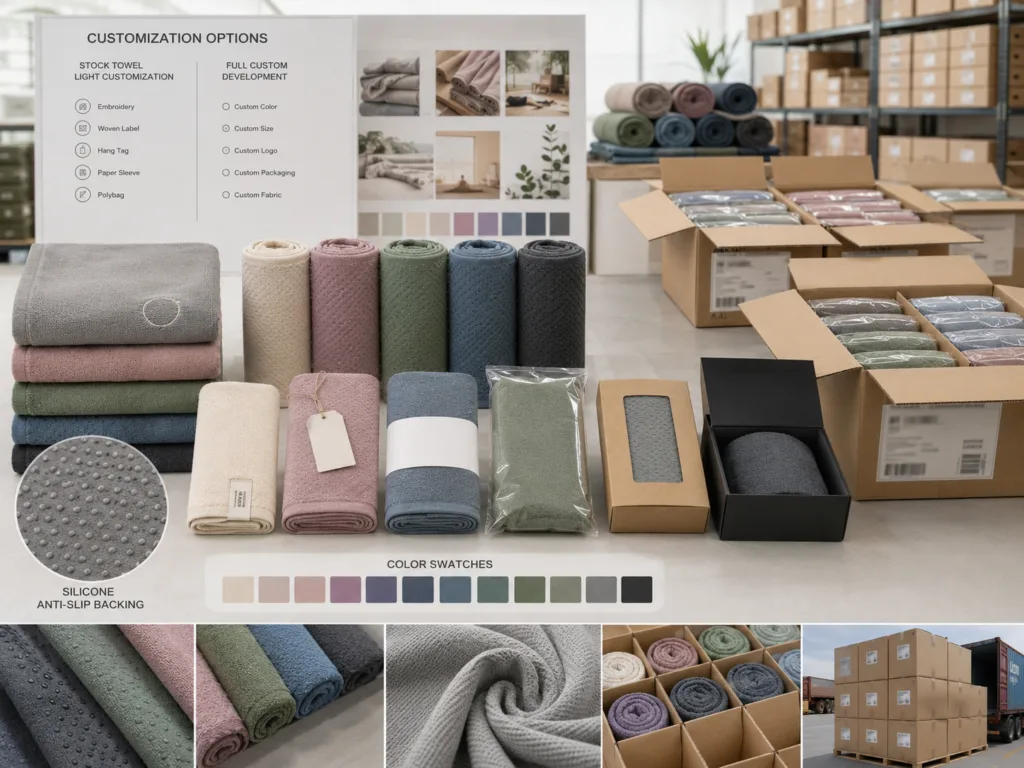
This is one of the most important points for buyers to understand before requesting a quote. Not every customization project has the same cost structure.
Option 1: Stock Fabric with Light Customization
This is the most cost-efficient path. The supplier uses existing fabric, existing color options or available sizes, then adds light customization such as logo embroidery, printed logo, woven label, hang tag, paper band or simple packaging.
This option is suitable for buyers who want to test the market, launch quickly or keep MOQ lower.
Possible advantages:
- Lower sample cost
- Faster sample lead time
- Lower MOQ
- Less development risk
- Easier price control
- Suitable for small studios and first orders
Light customization can include:
- Embroidered logo
- Printed logo
- Woven label
- Custom hang tag
- Paper sleeve
- Branded polybag
- Simple retail packaging
For many studios, gyms and wellness brands, this is the smartest first step. It allows the buyer to validate color preference, selling price, member feedback and repeat demand before investing in full custom development.
Option 2: Full Custom Development
Full custom means the buyer wants to control more details: new color dyeing, custom size, custom fabric texture, custom GSM, special silicone backing, customized pattern, private label packaging and possibly a full retail collection.
This route gives the strongest brand differentiation but requires higher commitment.
Full custom may involve:
- Fabric dyeing
- Color lab dip approval
- Custom GSM selection
- Custom cutting size
- Custom silicone mold or grip layout
- Custom print pattern
- Special packaging structure
- Carton planning for retail distribution
Because full custom development involves more production steps, the sample cost is usually higher. If dyeing is required, the supplier must prepare color matching, material testing and small-batch production. If a new size or grip design requires mold or special setup, additional tooling or development cost may apply.
For full custom projects, MOQ is often 1,000 pieces or above. This is especially true when the order requires new color dyeing, custom silicone backing or non-standard dimensions.
This is not because the supplier wants to make the project difficult. It is because fabric production, dyeing, silicone backing and packaging setup all have minimum production requirements. For mature buyers, this MOQ logic is normal and should be included in product planning.
Logo Customization Methods
Logo placement and technique affect the final look, durability and unit cost.
Embroidery
Embroidery gives a premium and durable effect. It works well for studio towels, gym towels and wellness brands that want a clean logo presentation. However, embroidery may not be ideal for very detailed or gradient logos.
Best for:
- Small logo placement
- Premium studio branding
- Simple brand marks
- Durable washing performance
Digital Printing
Digital printing is suitable for full-surface patterns, artwork, gradients and lifestyle designs. It is especially good for suede microfiber yoga towels. Buyers can create seasonal collections, branded patterns or retail designs.
Best for:
- Full towel artwork
- Pattern collections
- Retail products
- Colorful designs
Woven Label
A woven label is a subtle and professional branding method. It is suitable for buyers who want a premium look without printing directly on the towel surface.
Best for:
- Private label products
- Minimalist wellness brands
- Boutique studio towels
Heat Transfer or Printed Logo
Printed logo or heat transfer can be cost-effective for simple branding. The buyer should confirm washing durability and handfeel before bulk production.
Best for:
- Promotional orders
- Low-cost branding
- Simple logo application
Packaging Options for Wholesale, Retail and Studio Use
Packaging should match the buyer’s sales channel. A studio rental towel does not need the same packaging as a retail product sold in a wellness shop.
Bulk Packing
Bulk packing is suitable for studios, gyms and hotels that use towels internally. It keeps costs lower and reduces unnecessary packaging waste.
Best for:
- Studio use
- Gym rental towels
- Hotel fitness centers
- Large-volume operational orders
Individual Polybag
Individual polybag packing protects each towel and makes inventory management easier. It is also useful for Amazon sellers, distributors and retail buyers.
Best for:
- Wholesale distribution
- Online selling
- Basic retail protection
Paper Band or Paper Sleeve
A paper band creates a cleaner retail look without a heavy packaging cost. It is suitable for wellness brands that want a more eco-conscious and minimalist presentation.
Best for:
- Boutique yoga studios
- Wellness brands
- Gift products
- Retail shelf display
Gift Box or Retail Box
Gift boxes are suitable for premium sets, seasonal promotions, corporate wellness gifts and higher-priced retail products. However, boxes increase cost, packing volume and shipping weight, so buyers should evaluate margin carefully.
Best for:
- Premium yoga towel sets
- Corporate wellness gifts
- Holiday campaigns
- Retail collections
Towel Set Packaging
A strong retail concept is a full-size yoga towel plus a hand towel, packed as a set. Another option is a Pilates towel plus grip socks or resistance band, depending on the brand’s product range.
For mature buyers, packaging is not only about appearance. It affects landed cost, carton quantity, warehouse storage, shipping efficiency and final retail margin.
Quality Control Points Before Bulk Production
Before placing a bulk order, buyers should confirm more than color and logo. A professional towel supplier should help review the following quality points:
Absorbency
The towel should absorb sweat quickly without leaving the surface unpleasantly wet. For hot yoga and fitness use, absorbency is a core performance factor.
Grip Performance
The anti-slip backing should be tested on yoga mats, reformer surfaces or studio equipment. Buyers should test both dry and sweaty conditions.
Color Fastness
Dark colors, bright colors and printed patterns should be checked for color fastness. This is especially important for products that will touch skin, mats or light-colored clothing.
Washing Durability
Studio towels may be washed frequently. The towel should maintain shape, grip and softness after repeated washing.
Edge Stitching
Weak stitching can cause fraying after use. Clean, strong edges make the towel feel more premium and reduce complaints.
Silicone Adhesion
The anti-slip silicone should not peel easily. Poor silicone quality can destroy the product’s reputation after only a few uses.
Logo Durability
Embroidery, printing, woven labels and heat transfer logos should be checked after washing. A beautiful sample is not enough if the logo fails in real use.
Certifications and Compliance Buyers May Ask About
For North American and European buyers, product safety and responsible sourcing are becoming more important. Depending on the order type and buyer requirements, suppliers may need to provide relevant testing or compliance documents.
Common buyer concerns include:
- Textile safety testing
- Color fastness reports
- Material composition
- Packaging requirements
- Labeling requirements
- Factory audit information
- Social compliance expectations
For towels that come into direct contact with skin, certifications such as OEKO-TEX STANDARD 100 can be valuable for buyer confidence. For larger brands and retailers, factory audit expectations may also be part of vendor approval.
Not every order requires every certificate, but mature buyers should discuss compliance early, especially before launching retail products in the EU, UK, US, Canada or Australia.
Lead Time: From Sample to Bulk Order
Lead time depends on the customization level.
For stock fabric with light customization, sample lead time is usually much shorter. A logo sample, packaging mockup or color confirmation can often be arranged faster because the base towel already exists.
For full custom development, lead time is longer because the process may include:
- Fabric selection
- Color lab dip
- Dyeing
- GSM confirmation
- Anti-slip backing test
- Logo sample
- Packaging sample
- Pre-production sample
- Bulk production
- Final inspection
- Shipping arrangement
Buyers preparing seasonal campaigns, retail launches or studio openings should leave enough time for sample approval and bulk production. Rushing full custom development often leads to higher cost and higher risk.
How to Choose the Right Supplier for Custom Yoga and Pilates Towels
A good supplier should do more than quote a low price. For mature buyers, the best supplier is one that understands product use, development cost, MOQ logic, packaging efficiency and export requirements.
Before confirming an order, buyers should ask:
- Does the supplier understand the difference between yoga, Pilates and gym towel use?
- Can they recommend suitable GSM based on application?
- Do they have existing fabric and size options for lower MOQ orders?
- Can they explain when full customization requires higher sample cost?
- Can they support logo, label, hang tag and retail packaging?
- Can they provide clear sample lead time and bulk production timeline?
- Can they arrange export packing for international shipment?
- Can they support repeat orders with consistent color and quality?
For a serious B2B buyer, the lowest unit price is not always the best choice. A poorly developed towel may create complaints, returns, low retail sell-through and brand damage. A stable supplier helps reduce these risks.
Recommended Sourcing Strategy for Different Buyers
For Small Studios and First-Time Buyers
Start with stock fabric and light customization. Choose available colors and standard sizes, then add a logo, woven label or simple packaging. This keeps the MOQ lower and allows you to test real demand.
For Growing Studio Chains
Develop a consistent towel program. Use one or two core colors, add branded packaging and consider a full-size yoga towel plus hand towel set. Focus on durability and repeat supply.
For Retailers and Wellness Brands
Build a product collection. Consider custom colors, printed patterns, premium packaging and seasonal launches. Prepare for higher MOQ and more detailed sampling.
For Importers and Distributors
Focus on scalable SKUs. Choose several reliable sizes and colors, control packaging cost and request carton details early. Your goal is stable margin, easy warehousing and repeatable supply.
Final Thoughts: Build a Towel Product That Sells, Performs and Reorders
Custom non-slip yoga and Pilates towels are strong B2B products because they combine function, branding and repeat use. For studios and gyms, they improve the member experience and create a professional visual identity. For wellness brands and retailers, they offer a practical product category with clear lifestyle value and strong customization potential.
The best development path depends on your business stage. If you want to test the market, stock options with light customization are more cost-efficient and usually come with lower MOQ. If you are building a serious private label collection, full custom development gives stronger brand differentiation but requires higher sample cost, longer lead time and MOQ of 1,000 pieces or more.
A successful bulk order starts with clear product planning: fabric, GSM, size, anti-slip backing, logo method, packaging, compliance and shipping. When these details are confirmed early, the final product is easier to quote, sample, produce and reorder.
If you are sourcing custom non-slip yoga towels or Pilates towels for studios, gyms, wellness brands or wholesale distribution, the right supplier can help you balance performance, price, customization and delivery — so your towel is not only beautiful in a product photo, but reliable in real daily use.
FAQ
1. What is the best fabric for custom non-slip yoga towels?
Microfiber and suede microfiber are the most common choices for yoga and Pilates towels because they are absorbent, lightweight, quick-drying and suitable for printing. Cotton blend can be used for a softer, more natural handfeel, but it may dry more slowly and feel heavier after absorbing sweat.
2. What is the MOQ for custom non-slip yoga and Pilates towels?
MOQ depends on the customization level. Stock fabric with light customization, such as logo embroidery, woven labels or simple packaging, can usually support lower MOQ. Full custom development involving new colors, dyeing, custom size, special anti-slip backing or custom packaging usually requires higher MOQ, often 1,000 pieces or more.
3. Why is the sample cost higher for fully customized towels?
Full custom samples may require fabric dyeing, color matching, special cutting, silicone backing setup, logo testing and packaging development. These steps involve material, labor and setup costs before bulk production begins. For this reason, full custom samples are more expensive than samples made from existing stock fabric or standard sizes.