
Introduction to Print on Demand and Bulk Custom Towels
For B2B buyers and brands exploring new product lines or promotional campaigns, the choice between print on demand towels and custom towels bulk can significantly affect costs, branding, and operational success. As more hospitality, retail, sports, wellness, and promotional businesses seek agility, understanding the difference between these two popular production models is essential for making informed decisions.
Print on demand towels allow buyers to create customized towel designs one at a time or in small batches, with goods produced only when an order is placed. This model is favored for low-risk market testing, personalized gifts, and promotional launches where flexibility and low upfront investment are key.
In contrast, custom towels bulk production—sometimes referenced as wholesale custom towels—means placing a larger order with a manufacturer, typically meeting minimum order quantities (MOQs). Bulk manufacturing offers lower unit prices but requires a larger upfront financial commitment. Choosing the right model depends not only on budget and timeline but also on brand needs and anticipated demand.
Print on demand towels are often chosen for entrepreneurial startups, microbrands, or companies with highly seasonal or event-driven demand. Bulk custom towels are typically preferred by established brands, hospitality chains, sports clubs, and large-scale retailers where consistency, advanced branding options, and economies of scale drive profitability.
Cost Comparison: Unit Price Dynamics

Understanding production economics is critical to towel sourcing success. Small orders using print on demand methods come with a higher per-unit price due to customized processing, individual packaging, and shipment per item. While you avoid inventory risk, cost control becomes more challenging as sales volume rises.
For custom towels bulk and wholesale custom towels, suppliers usually offer significant volume discounts once orders surpass their standard MOQs, such as 100, 500, or 1,000 pieces. The unit cost often drops 30–60% over the lowest print on demand price as order size increases.
| Sourcing Model | Typical Order Size | Unit Price Range (USD) | MOQ | Shipping Model |
|---|---|---|---|---|
| Print on Demand Towels | 1–100 pcs | $8–$18+ | No MOQ | Parcel / Courier |
| Custom Towels Bulk | 100–10,000 pcs+ | $3–$9 | 100–500 pcs | Bulk / Freight |
POD pricing factors include customized printing setup, cotton or microfiber base towel selection, and even single-item pre-shipping packaging. For bulk manufacturing, savings relate to production efficiencies, optimized logistics, and standard packaging such as export carton packing.
Shipping costs also diverge: print on demand towels often incur higher per-item fees, while bulk orders benefit from freight or container rates that significantly cut per-towel delivery cost. Over the long term, brands ready for mass sales typically achieve greater profit margins and cost control through bulk manufacturing, while small and new entrants benefit from the reduced risk and flexibility of POD.
For more guidance on towel materials and MOQ planning, Circe Towel’s custom towel MOQ and cost structure guide offers practical tips for bulk buyers.
Control and Flexibility of Production
One of the central advantages of print on demand towels is design flexibility. Buyers can quickly launch new graphic concepts, personalized logos, or test seasonal motifs without major commitments or long negotiations. Many POD platforms allow for edits or even version switches between print runs, making it easy to iterate based on market feedback.
In contrast, bulk towel production involves design confirmation and technical sampling prior to mass production. Once production commences, design changes become impractical—or costly—since everything from weaving to color matching and label sewing is queued for high-volume output. This means greater commitment to your original spec, but higher consistency across units.
Stock management also differs: POD eliminates the need for warehousing towels, ideal for small brands or those targeting limited promotions. Bulk orders require inventory management but ensure timely fulfillment for wholesale distribution or larger retail rollouts. For brands expecting sharp seasonal demand spikes or short PR-driven projects, POD can offer a lower-risk entry point to market.
- Quick design changes are possible with print on demand towels.
- Bulk orders lock in cost and quality but restrict alterations after confirmation.
- POD reduces overstock risk but may extend fulfillment time for high volume.
Buyers should consider if their launch window, order sizes, or SKU variety justifies a flexible or locked-in production workflow.
Turnaround Time: POD vs Bulk Orders
Lead time is a decisive factor for time-sensitive projects. Print on demand beach towels can be produced and shipped individually, often within 2–7 days after order confirmation. This speed supports limited runs, small events, or fast-launch promotional campaigns requiring rapid market entry.
Bulk custom orders, depending on factory schedule and complexity, typically require 20–40 days from approved sample to shipment—plus transit time (sea or air freight) to the destination. While this longer cycle enables better pricing, it can pose challenges if market timing or supply chain delays are critical.
For urgent event launches or last-minute brand pivots, POD minimizes lead time risk. However, brands planning for major rollouts (such as summer beach towel lines or hotel buys) must balance longer production with the rewards of bulk discounts and advanced customization.
Throughout the process, communication with your manufacturing partner ensures expectations are aligned, artwork is received and approved promptly, and options for expediting production or priority shipping (at a cost premium) are clarified. For extended seasonal lead times, reserve sample approval capacity and confirm packaging early for best results. Circe Towel’s experience shows proper timeline planning reduces missed launch windows and supply bottlenecks.
For those considering larger beach towel orders, you can review Circe Towel’s advice on how to order beach towels in bulk with your own logo.
Brand Perception and Market Fit
How your towels look and feel directly impacts brand value in customer eyes. Choosing between print on demand towels and custom towels bulk shapes not just budget and turnaround, but the perception of quality, exclusivity, and professionalism. In POD models, brands can roll out diverse, personalized, or season-specific designs with robust digital printing options. However, tactile quality, weave selection, and finishing details may be more limited compared to bulk methods.
Bulk manufacturing enables more refined finishing options, including custom woven borders, jacquard logos, premium label sewing, and advanced embroidery—all of which reinforce a high-end image. This is especially important for hospitality, sports, or luxury retail applications where tactile feel and wash durability leave lasting impressions. The choice of print, embroidery, or jacquard also affects both appearance and long-term performance.
The ability to choose construction methods—like terry or velour—as well as packaging style (for instance, private label boxes or export-ready cartons) raises the premium perception in the eyes of end users or channel partners. Brands who have moved from POD to bulk with Circe Towel consistently report improved customer reviews and loyalty thanks to these elevated touches.
For more comparative branding options, read Circe Towel’s showdown on printing, embroidery, and jacquard for logo towels.
Material Comparison: Choosing the Right Fabric
Material selection is the foundation of a towel’s performance and user appeal. Buyers must weigh practical factors—including softness, absorbency, drying speed, durability, and eco-friendliness—against cost and target market.
Cotton is prized for its natural softness and absorbency, making it ideal for bath and hotel towels. Microfiber, with faster drying and a slicker feel, often wins for gym, sports, and outdoor beach towels. Bamboo blends are increasingly sought out by eco-conscious buyers for their sustainability and smooth hand feel, but may add cost.
Print on demand platforms tend to offer a limited selection—most often standard white cotton or microfiber towels optimized for digital or sublimation printing. In contrast, bulk manufacturing opens up choices for specialty fibers: zero-twist, long-staple cotton for high-end hospitality; heavy GSM options for spas; or jacquard weave for durable branding.
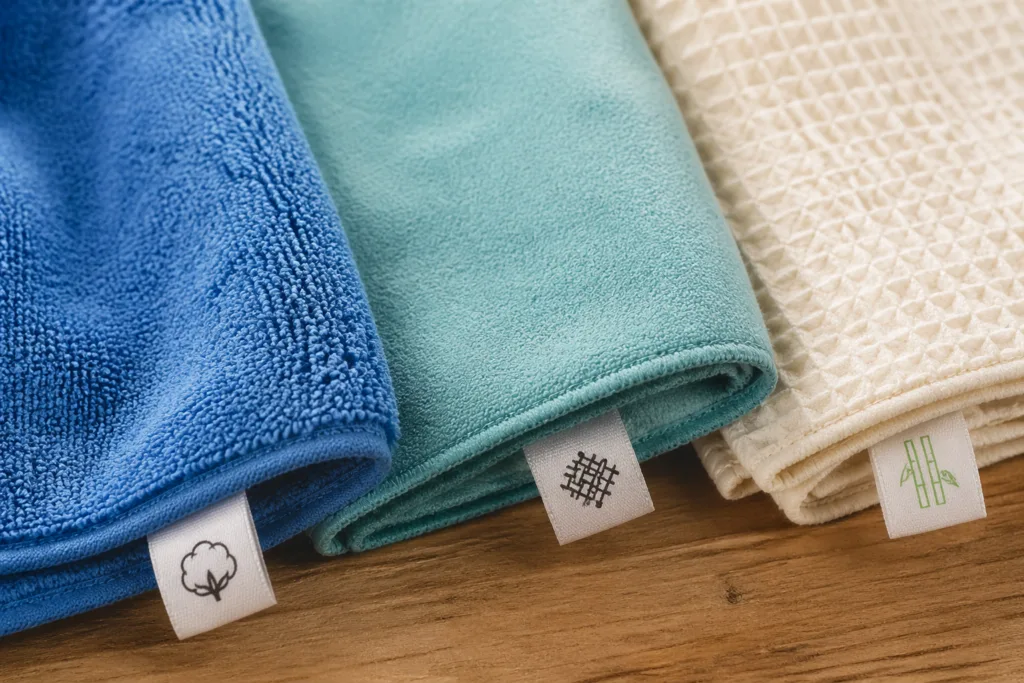
Consider these trade-offs:
- Cotton maximizes comfort but may dry more slowly than microfiber.
- Higher GSM means thicker, more absorbent towels—but with extra weight and slower drying.
- Microfiber offers vivid color and rapid drying but a less plush hand feel.
If sustainability is a project goal, check for OEKO-TEX or GOTS certifications, and explore recycled yarn options. For an in-depth look at textile options and branding strategies, see Circe Towel’s towel materials and customization guide.
Construction and Manufacturing Methodologies
Towel construction shapes both appearance and function. Key manufacturing styles include terry (with looped piles for superior absorbency), velour (sheared for a smooth, print-ready surface), and waffle (for lightweight quick drying and a textured aesthetic). Each lends itself to specific branding and performance goals.
| Construction Type | Best For | Printing Methods | Notes |
|---|---|---|---|
| Terry | Bath, Hotel, Spa, Gym | Embroidery, Jacquard | High absorbency, plush feel |
| Velour | Beach, Promo, Retail | Digital, Reactive, Sublimation | Smooth print surface, vivid colors |
| Waffle | Kitchen, Travel, Sports | Embroidery, Limited Print | Lightweight, fast drying |
In print on demand, most production defaults to digital or sublimation print on plain terry or velour. Bulk custom manufacturing, on the other hand, offers advanced jacquard weaving, precision embroidery, and specialty edge finishes—often unavailable in small-batch POD models. This makes bulk preferable for hotels, gyms, and retailers aiming for durability and distinct brand character.
Selection should factor in use cases: hotels prize wash durability and consistent sizing, promotional brands may need cost-effective printing at scale, while retail brands weigh both shelf appeal and function. For in-depth methodology comparisons, Circe Towel’s guide to jacquard towel manufacturing is a valuable resource.
Design & Spec Checklist for Towel Products
Before placing an order, use this checklist to verify design and specification details that impact cost, performance, and branding success.
| Spec Area | Key Considerations |
|---|---|
| Size | End use (bath, hand, face, gym, beach) |
| GSM | Desired thickness, absorbency vs quick drying |
| Material | Cotton, microfiber, bamboo, blends |
| Edge Finishing | Double stitching, binding, fringes, or plain |
| Absorbency | Fiber type, pile height, loop twist |
| Logo Method | Embroidery, digital print, reactive print, jacquard |
| Packaging | Retail, private label, export bulk |
| Quality Control | Sample approval, colorfastness, wash tests |
| Pricing Influences | MOQ, design complexity, branding techniques |
Taking time to detail GSM, size, and packaging from the start will reduce revision costs and avoid brand-damaging errors down the line.
Quality Assurance and Testing Guidelines
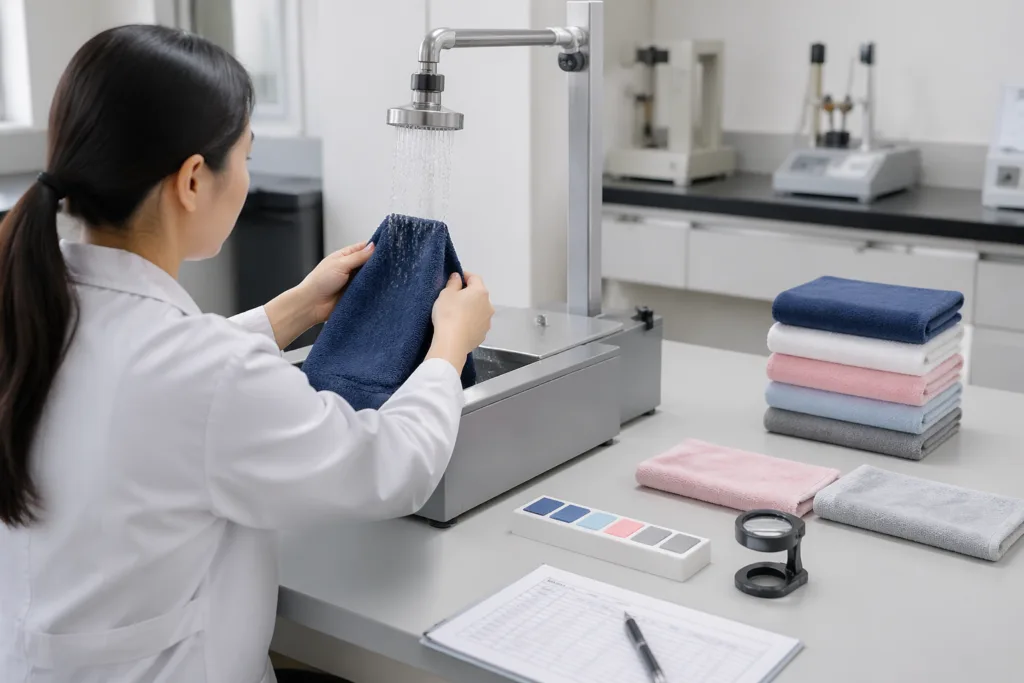
Quality assurance protects both your brand reputation and your investment. Key quality metrics include absorbency (amount of water absorbed per gram), wash durability (resistance to thinning, fading, or pilling after repeated washes), and shrinkage control. For both POD and bulk, colorfastness (resistance to fading) and stitching integrity are essential checks.
Recommended tests include water absorption rate, standard shrinkage wash cycles, and visual inspections in natural light. Be particularly cautious with lower-GSM promotional towels or complex prints, as these components can impact usability and customer satisfaction. In the case of print on demand towels, inconsistent quality may arise from rush processing, while bulk custom towels depend on responsible mass production and systematic QC procedures.
To mitigate risks, always approve samples before main production, and ensure suppliers conduct in-line and final random inspections. Circe Towel implements pre-shipment testing and offers third-party quality audit options for buyers pursuing large or high-stakes orders.
Relevant reading: How quality is tested before shipping
Common Mistakes and Troubleshooting in Towel Procurement
A few common pitfalls can lead to disappointing towel orders. Selecting the wrong GSM can leave towels too thin (for hotel/spa use) or excessively heavy for promotional giveaways. Choosing polyester-dominant or sub-par blends for absorbency-intensive markets like hospitality may also backfire.
Poor colorfastness or weak stitching can generate high return rates and affect brand credibility. Mid-level errors include neglecting to test finished samples or skipping packaging reviews. Post-production troubleshooting includes adjusting wash instructions, replacing batches affected by high shrinkage, or repackaging for resale.
- Align towel spec to the market’s typical expectation (retail vs hospitality vs promo)
- Request pre-production samples whenever possible
- Factor in local washing/drying conditions for material choice
Swiftly addressing end-user feedback and maintaining open supplier communication prevents repeat quality issues.
Ordering Guide: Navigating MOQ and Lead Times
Minimum order quantities (MOQs) and lead times are crucial elements of the towel sourcing process. Print on demand towels feature no (or very low) MOQs, allowing for single-piece or micro-batch orders on demand. This model suits market testing or smaller events but comes at a unit cost premium.
Bulk custom towels usually have MOQs of 100–500 pieces, based on fabric type, weaving technique, and logo method. Lead times for bulk orders depend on factory production scheduling, order complexity, and shipping route, ranging from 20–40 days or more. Artwork finalization, proof approval, and sample shipping can also affect timelines.
Packaging decisions matter: will towels be packed for retail shelf display, private label, or bulk export? Each approach impacts both cost and supply chain efficiency. Shipping can be arranged via express courier for small POD orders, or consolidated container shipments for bulk purchases to save costs.
To maximize success, develop clear tech packs and artwork files, understand holiday or seasonal slowdowns, and plan adequate buffer before product launch.
Useful resources: Complete towel manufacturing, MOQ, and lead time explainer
Frequently Asked Questions
How do I choose between print on demand towels and bulk custom towels?
If you’re testing new designs, handling small runs, or want minimal upfront investment, print on demand towels offer flexibility; for proven markets and better pricing, bulk custom towels are more cost-effective and support advanced branding.
Can I modify my towel design after ordering?
With print on demand, you can often edit designs for future orders; bulk manufacturing requires final approval before production, so post-order changes are not possible once production starts.
How do I ensure quality with print on demand towels?
Order a sample before launch, check print sharpness, stitching, and fabric quality, and review supplier quality control processes to prevent surprises in the finished product.
What customization options can I choose for both sourcing models?
Print on demand offers digital printing and limited material choice; bulk supports embroidery, woven borders, jacquard, advanced packaging, and custom construction for elevated branding.
Are POD towels suitable for urgent promotional needs?
Yes, print on demand towels can be produced in days, making them ideal for last-minute giveaways or quick-turnaround events, but unit cost will be higher versus pre-planned bulk orders.
Are eco-friendly towel fabrics available for both models?
Eco options like bamboo blend or recycled fiber are becoming common in bulk programs; print on demand platforms offer fewer choices, so consult suppliers about available sustainable materials for your project.
Related Reading
- Understand Private Label Towel MOQ and Pricing Structure for Smarter Sourcing
- Explore Custom Towel Materials and Branding Strategies for Your Market
- Compare Printing, Embroidery, and Jacquard: Find the Best Branding Method for Towels
- Master the Complete Towel Manufacturing Process: MOQ, Sampling, and Lead Time Explained
- See What Top Brands Check in Towel Quality Tests Before Shipping