
For hotels, retailers, importers, promotional companies, spa brands, and private label buyers, controlling Custom Towel Costs is not simply about asking for the lowest unit price. A towel is a textile product with many cost layers: yarn, GSM, size, weaving method, dyeing, logo technique, packaging, testing, carton packing, and shipping method. When one specification changes, the whole cost structure can change.
The real challenge is not how to make a towel cheaper. The real challenge is how to reduce unnecessary costs while keeping the towel soft, absorbent, durable, washable, and commercially suitable for the target market.

This is where experienced bulk buyers separate themselves from small trial buyers. Mature buyers do not only ask, “How much is one towel?” They ask better questions:
- What GSM is suitable for this use case?
- Can we use an existing yarn or existing color?
- Is the size optimized for carton packing?
- Is embroidery better than jacquard for this order?
- Can packaging be simplified without hurting retail presentation?
- Can multiple SKUs share the same base fabric?
- Can the order quantity support stable production?
At Circe Towel, we work with B2B buyers who need custom towels for real commercial use, not just one-off samples. This guide explains how to reduce custom towel costs without damaging the product quality your customers will actually feel.
1. Why Custom Towel Costs Matter for Serious Bulk Buyers
For bulk towel buyers, cost control affects more than the purchase order. It affects retail margin, hotel operating cost, inventory planning, customer satisfaction, and reorder stability.
A towel that is too expensive may reduce your profit margin. But a towel that is too cheap may create bigger problems:
- Poor absorbency
- Rough hand feel
- Shrinkage after washing
- Weak stitching
- Color bleeding
- Low durability
- Customer complaints
- Higher replacement rate
- Poor brand perception
For hotels, towels are used and washed repeatedly. For retailers, towels must look attractive on shelves and survive customer reviews. For importers and wholesalers, towels must balance price, carton volume, and repeatable quality. For private label brands, towels must match brand positioning.
That means Custom Towel Costs should be managed strategically, not randomly reduced.
The best cost-saving approach is not to remove quality. It is to remove waste.
2. What Actually Drives Custom Towel Costs
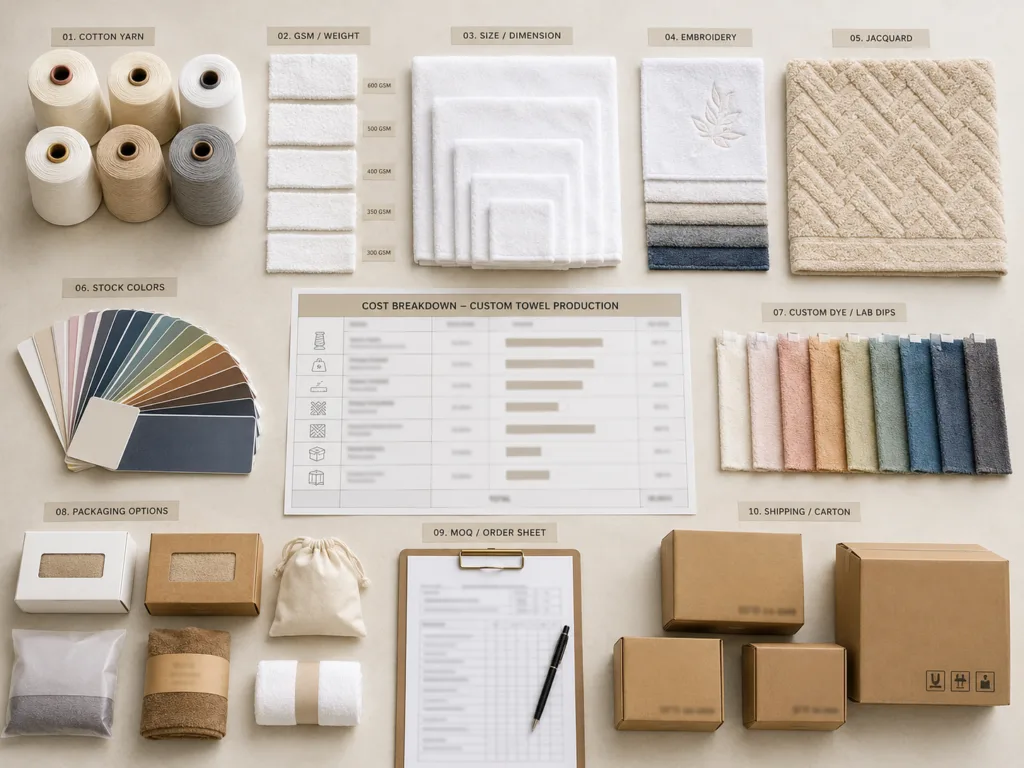
Many buyers assume towel cost is mainly determined by cotton price. Cotton is important, but it is only one part of the full cost.
The main cost drivers include:
| Cost Factor | Why It Matters |
|---|---|
| Yarn type | Affects softness, strength, absorbency, and price |
| GSM | Higher GSM uses more material and increases weight |
| Size | Larger towels require more yarn and increase shipping volume |
| Weaving method | Terry, velour, waffle, jacquard, and dobby have different costs |
| Logo technique | Embroidery, jacquard, printing, woven label, and heat transfer vary widely |
| Color | Stock colors are usually more cost-efficient than custom dyeing |
| Packaging | Simple packing and retail gift boxes have very different costs |
| MOQ | Larger quantities spread fixed costs across more units |
| Shipping method | Air freight, sea freight, DDP, and FOB all affect landed cost |
| Quality control | Testing and inspection prevent costly failures |
A professional custom towel quotation should not be a random number. It should be the result of a clear specification discussion.
At Circe Towel, we usually evaluate towel projects based on yarn, GSM, size, finishing, color, branding, packing, quantity, and delivery destination before giving a practical quotation.
3. Yarn Selection: Where Quality Starts
Yarn is one of the most important factors behind towel quality. It affects softness, absorbency, durability, linting, and washing performance.
Common towel yarn options include:
Ring-Spun Cotton
Ring-spun cotton is widely used for bath towels, hotel towels, and retail towels. It provides a good balance between softness, durability, and cost.
Combed Cotton
Combed cotton removes shorter fibers and impurities. It usually feels smoother and produces a cleaner towel surface. It is suitable for premium retail towels and better hotel programs.
Long-Staple Cotton
Long-staple cotton offers better softness and strength. It is suitable for high-end towel lines, luxury hotels, spa collections, and premium private label brands.
Organic Cotton
Organic cotton is attractive for eco-conscious brands, but it normally comes with higher raw material cost and higher MOQ requirements. Buyers should use it when sustainability is a real selling point, not just a decorative claim.
Microfiber
Microfiber is common for sports towels, gym towels, travel towels, yoga towels, cleaning towels, and quick-dry beach towels. It is lightweight, fast drying, and often more compact for packing.
Cost-Saving Advice
Do not choose the most expensive yarn automatically. Choose the yarn that matches the product position.
For example, a luxury hotel bath towel may justify combed cotton or long-staple cotton. A promotional gym towel may not. A beach towel may need faster drying and strong color performance more than extreme plushness.
The smartest way to reduce Custom Towel Costs is to choose the correct yarn for the usage scenario.
4. GSM Planning: How to Avoid Overpaying for Weight
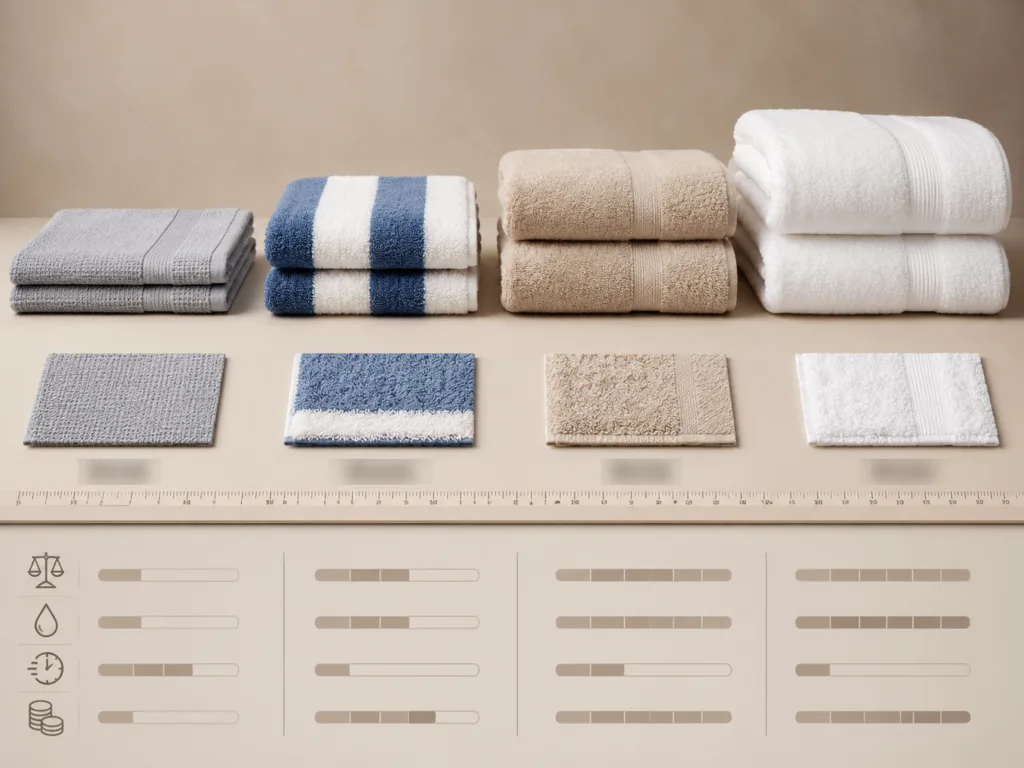
GSM means grams per square meter. It directly affects towel thickness, weight, absorbency, drying speed, and cost.
Higher GSM usually means more cotton, more weight, and higher cost. But higher GSM does not always mean better performance.
Recommended GSM by Towel Type
| Towel Type | Common GSM Range | Best For |
|---|---|---|
| Hotel bath towel | 500–650 GSM | Daily hotel use, softness, absorbency |
| Retail bath towel | 450–600 GSM | Home use, balanced quality |
| Luxury spa towel | 600–750 GSM | Premium hand feel |
| Beach towel | 350–450 GSM | Fast drying, larger size, travel use |
| Gym towel | 300–450 GSM | Lightweight, frequent washing |
| Yoga towel | 250–400 GSM | Grip, quick dry, portability |
| Promotional towel | 300–400 GSM | Budget-sensitive campaigns |
| Hand towel | 400–550 GSM | Hotel, spa, bathroom use |
| Face towel | 350–500 GSM | Softness, daily contact with skin |
Where Buyers Waste Money
Some buyers request very high GSM because they think heavier towels are always more premium. But this can create problems:
- Higher unit cost
- Higher shipping cost
- Longer drying time
- Higher laundry energy use
- More carton volume
- Less suitable for beach, gym, or travel use
For example, a 700 GSM beach towel may sound luxurious, but it may dry slowly, trap sand, become heavy when wet, and cost more to ship. A 380–450 GSM beach towel may perform better for resort retail, summer promotions, and travel customers.
Cost-Saving Advice
Use GSM as a performance tool, not a vanity number. The right GSM protects both quality and cost.
5. Size Optimization: Small Changes, Big Cost Impact
Size is another major cost factor. A few centimeters may seem minor, but in bulk production, size changes affect yarn consumption, carton quantity, shipping volume, and total landed cost.
Common Towel Sizes
| Product | Common Size |
|---|---|
| Face towel | 30 × 30 cm / 30 × 50 cm |
| Hand towel | 35 × 75 cm / 40 × 80 cm |
| Bath towel | 70 × 140 cm / 75 × 150 cm |
| Bath sheet | 80 × 160 cm / 90 × 180 cm |
| Beach towel | 80 × 160 cm / 90 × 180 cm |
| Yoga towel | 183 × 61 cm / 185 × 63 cm |
| Gym towel | 30 × 100 cm / 40 × 100 cm |
Why Size Affects Cost
A larger towel uses more yarn. It also increases carton size and shipping CBM. When the buyer orders thousands of pieces, the difference becomes significant.
For example, changing a beach towel from 80 × 160 cm to 100 × 180 cm increases material usage substantially. If the design does not require the larger size, this is unnecessary cost.
Cost-Saving Advice
Use standard commercial sizes unless a special size has a clear purpose. Standard sizes usually make production, packing, and quality control easier.
For mature buyers, size optimization is one of the cleanest ways to reduce Custom Towel Costs without lowering perceived quality.
6. Construction and Weaving Choices
The way a towel is constructed affects texture, absorbency, appearance, and price.
Terry Towel
Terry towels have looped piles that absorb water well. This is the most common structure for bath towels, hotel towels, hand towels, and face towels.
Velour Towel
Velour towels have one side sheared for a smooth surface. They are often used for printed beach towels because the surface shows patterns clearly. However, velour may absorb less than full terry.
Waffle Towel
Waffle towels are lightweight, textured, and quick drying. They are popular for spa, travel, home, and boutique hotel concepts.
Jacquard Towel
Jacquard towels weave the pattern or logo into the fabric. They look premium but usually require higher MOQ and more production planning.
Dobby Border
A dobby border adds a woven decorative band. It is often used for hotel towels and can improve appearance without full jacquard cost.
Cost-Saving Advice
Choose construction according to product function. Do not use jacquard if a woven label or embroidery can achieve the same branding goal at lower cost. Do not use velour if absorbency is the main selling point.
7. Logo and Branding Methods
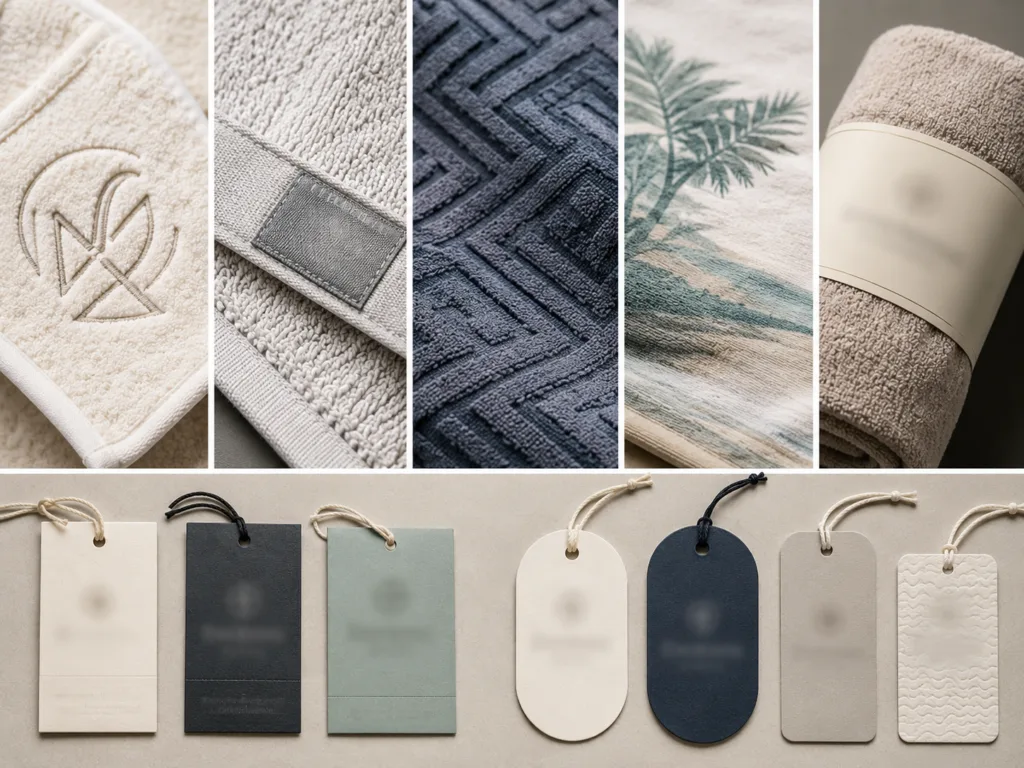
Branding is important for private label towels, hotel towels, spa towels, promotional towels, and retail towel collections. But logo method has a big impact on cost.
Common Logo Options
| Logo Method | Cost Level | Best For |
|---|---|---|
| Woven label | Low | Basic private label branding |
| Embroidery | Medium | Hotel, spa, corporate gift, premium feel |
| Printing | Medium | Beach towels, colorful retail designs |
| Jacquard logo | Higher | Large bulk orders, premium woven identity |
| Hang tag | Low to medium | Retail presentation |
| Paper belly band | Low to medium | Private label packaging |
| Heat transfer | Medium | Sports towels, microfiber towels |
When to Choose Embroidery
Embroidery is suitable when the logo is small, clean, and positioned on the towel corner or border. It gives a premium look without changing the whole towel construction.
When to Choose Jacquard
Jacquard is suitable for large orders where the logo or pattern is part of the towel itself. It works well for hotels, resorts, and established brands, but it is not ideal for very small quantities.
When to Choose Printing
Printing is useful for beach towels and decorative retail towels. Digital printing can support complex artwork, while screen printing may be better for simpler designs and larger runs.
Cost-Saving Advice
For many private label buyers, the most cost-effective starting point is:
H5: Existing fabric + custom logo + custom packaging
This keeps the product professional while avoiding unnecessary fabric development cost.
8. Color Strategy: Stock Colors vs Custom Dyeing
Color can quietly increase custom towel costs.
Custom dyeing may involve:
- Dyeing minimum quantity
- Lab dip development
- Color matching time
- Higher rejection risk
- Longer lead time
- Color difference control
- Additional testing for color fastness
Stock colors are usually more cost-efficient because the yarn or fabric is already available. For smaller bulk orders or first production runs, stock colors can reduce cost and risk.
Smart Color Planning
If your brand color is important, you do not always need to dye the towel body in that exact Pantone color. You can express brand identity through:
- Embroidery color
- Woven label
- Hang tag
- Paper belly band
- Gift box
- Carton mark
- Retail insert card
Cost-Saving Advice
For first bulk orders, use classic towel colors such as white, ivory, beige, grey, navy, brown, black, or soft neutral tones. Custom Pantone dyeing is better for repeat orders or larger programs.
9. Packaging Costs: Retail Value vs Over-Engineering
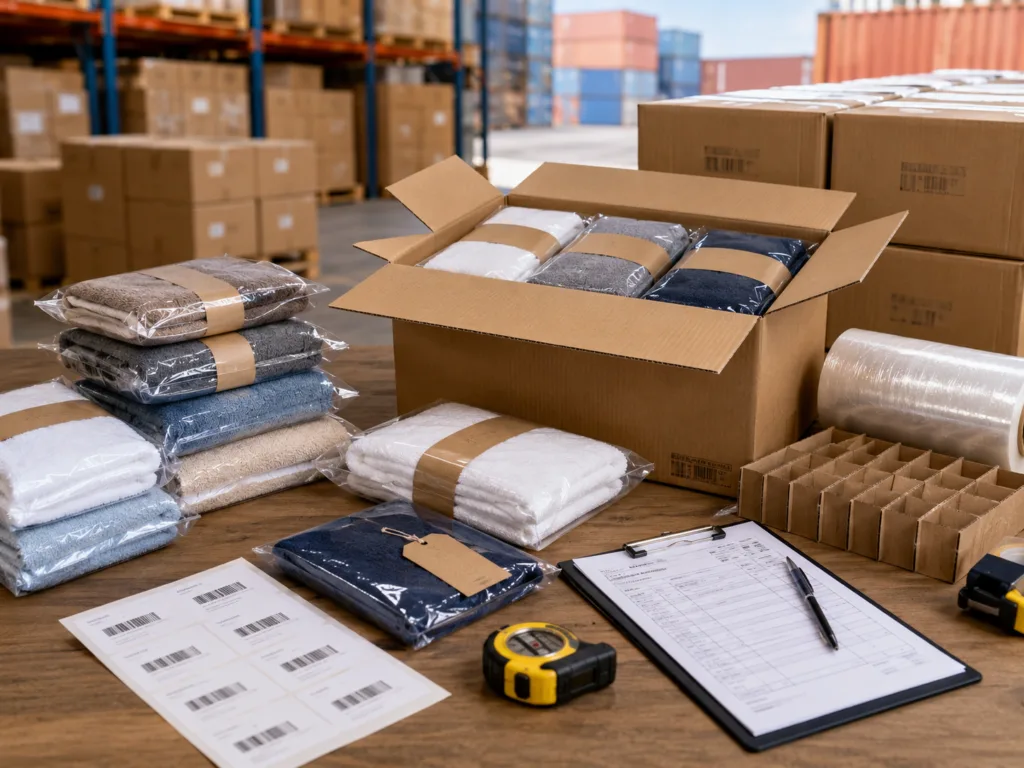
Packaging can make a towel feel more premium, but it can also increase cost quickly.
Common Packaging Options
| Packaging Type | Cost Level | Suitable Buyer |
|---|---|---|
| Bulk packing | Low | Hotels, laundries, wholesalers |
| Individual polybag | Low | Basic export protection |
| Sticker label | Low | Simple brand identification |
| Paper belly band | Medium-low | Retail/private label |
| Hang tag | Medium-low | Retail display |
| Barcode label | Medium-low | Retail and warehouse systems |
| Cotton bag | Medium | Gift sets, eco brands |
| Rigid gift box | High | Premium retail, corporate gifts |
| Custom carton | Medium-high | Large brand programs |
Where Buyers Overspend
Some buyers request luxury gift boxes too early. If the towel is not yet market-tested, expensive packaging may reduce profit and increase shipping volume.
For hotels and wholesalers, bulk packing may be enough. For retail brands, paper belly bands and hang tags may provide strong visual value without the cost of rigid boxes.
Cost-Saving Advice
Build packaging in stages:
H5: Stage 1: Bulk or simple individual packing
H5: Stage 2: Brand label, hang tag, or belly band
H5: Stage 3: Full retail gift box for proven SKUs
This protects cash flow and avoids unnecessary over-packaging.
10. MOQ and Order Quantity Strategy
MOQ is one of the most misunderstood parts of custom towel production.
Small quantity orders often have high unit prices because fixed costs cannot be spread efficiently. These fixed costs include:
- Material preparation
- Machine setup
- Dyeing setup
- Printing or embroidery setup
- Packaging setup
- Sampling coordination
- Export documentation
- Inspection
- Carton packing
A 100-piece order and a 5,000-piece order may both require similar communication and setup work, but the larger order spreads the fixed cost across more units.
How Mature Buyers Reduce Unit Cost
Large buyers often reduce costs by planning order structure carefully:
- Use the same fabric for multiple towel sizes
- Use the same color across several SKUs
- Use one logo method across the collection
- Reduce the number of colorways in the first order
- Increase quantity per SKU
- Combine bath towels, hand towels, and face towels in one production plan
- Use repeatable packaging formats
Cost-Saving Advice
If your goal is serious wholesale, hotel, or retail distribution, plan for commercial quantities. Custom towel production is most efficient when the buyer is ready for real bulk orders.
Circe Towel is best suited for buyers who want stable production, not extremely small one-time trial quantities.
11. Sampling Costs and How to Control Revisions
Sampling is necessary, but uncontrolled sampling can become expensive.
A custom towel sample may involve yarn selection, color matching, logo development, printing setup, embroidery programming, packaging mock-up, and international shipping. If specifications are unclear, multiple sample rounds may be needed.
Confirm These Details Before Sampling
- Towel type
- Size
- GSM
- Material
- Color
- Logo size
- Logo position
- Logo technique
- Packaging style
- Order quantity
- Target price
- Market positioning
- Delivery country
Why This Matters
When buyers provide complete specifications, suppliers can recommend a realistic solution earlier. When details are missing, the quotation may be inaccurate and samples may not match expectations.
Cost-Saving Advice
Sampling should test the final commercial direction, not every possible idea. The more precise the brief, the lower the development cost.
12. Logistics: How Carton Volume Affects Final Landed Cost
Many buyers focus only on the unit price and forget shipping cost. For towels, this is a serious mistake.
Towels are bulky products. Higher GSM, larger sizes, and excessive packaging all increase carton volume. This directly affects sea freight, air freight, warehouse handling, and final landed cost.
Logistics Factors That Affect Towel Cost
- Carton size
- Pieces per carton
- Carton weight
- Compression level
- Packaging volume
- Destination country
- Shipping method
- Customs clearance terms
- DDP, FOB, EXW, or CIF terms
Air Freight vs Sea Freight
Air freight is faster but expensive for bulky textile products. It may be acceptable for samples or urgent replenishment, but it is usually not ideal for large towel orders.
Sea freight is more suitable for commercial bulk orders, especially for importers, wholesalers, retailers, and hotel projects with planned delivery schedules.
Cost-Saving Advice
Plan carton packing early. A good supplier should consider not only product quality but also export packing efficiency.
13. Quality Control: Where Buyers Should Never Cut Corners
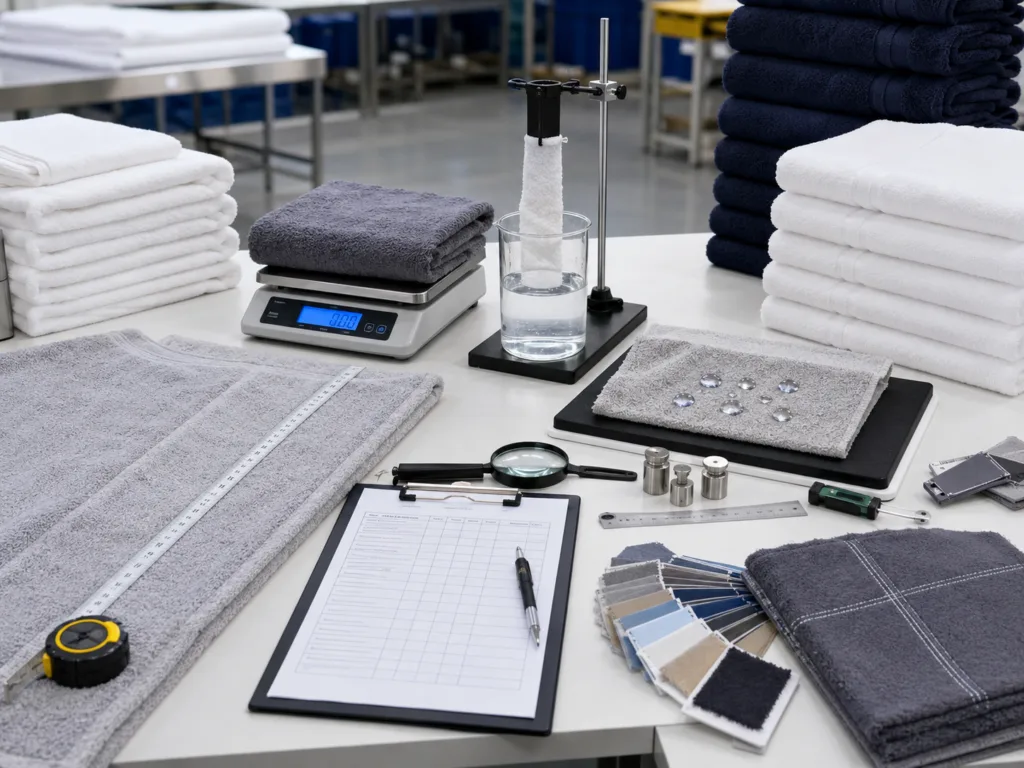
Cost reduction should never damage essential quality checks.
For custom towels, buyers should pay attention to:
- GSM tolerance
- Size tolerance
- Weight consistency
- Color fastness
- Shrinkage rate
- Absorbency
- Linting
- Stitching quality
- Logo position
- Packaging accuracy
- Carton marks
- Barcode labels
- Pre-shipment inspection
Common Quality Problems
Low-quality towels may look acceptable at first but fail after washing. Problems may include:
- Hard hand feel
- Excessive lint
- Twisted edges
- Loose threads
- Uneven dyeing
- Weak embroidery
- Poor absorbency
- Shrinkage beyond tolerance
Cost-Saving Advice
Never reduce cost by skipping basic quality control. It is cheaper to inspect before shipment than to handle complaints after delivery.
At Circe Towel, quality planning starts before production. We help buyers align material, GSM, size, logo, packaging, and inspection expectations before bulk production begins.
14. How Market Trends Influence Custom Towel Planning
Search and visual platforms show that towel demand is not only functional. Towels are connected to lifestyle, hospitality, wellness, travel, home decor, beach culture, gifting, and private label branding.
On Google, buyers often search for terms related to wholesale towels, custom towels, hotel towels, beach towels, bath towels, and private label towels. On Pinterest, towel content often connects with bathroom decor, beach lifestyle, spa styling, monogrammed gifts, and retail presentation. On B2B sourcing platforms, suppliers list a wide range of towel products with different MOQ levels, materials, and price points.
For serious buyers, this means one thing: cost control should not remove the product’s commercial value.
A towel for a resort gift shop needs visual appeal. A hotel towel needs durability. A spa towel needs softness and calm presentation. A promotional towel needs budget discipline. A private label towel needs brand consistency.
Cost-Saving Advice
Do not copy trends blindly. Translate market demand into a practical product specification.
15. Cost-Saving Formula for Hotels, Retailers, Importers, and Brands
Different buyers should reduce custom towel costs in different ways.
For Hotels
Hotels should focus on durability, absorbency, washing performance, and replacement cost.
Best cost-saving strategy:
- Use standard sizes
- Choose 500–650 GSM for bath towels
- Use white or neutral colors
- Add simple embroidery or dobby border
- Use bulk packing
- Prioritize washing durability over decorative packaging
For Retail Brands
Retailers need visual appeal, shelf presentation, and customer satisfaction.
Best cost-saving strategy:
- Use balanced GSM
- Choose attractive but repeatable colors
- Use paper belly band or hang tag
- Keep packaging lightweight
- Start with fewer SKUs
- Scale winning colors after market feedback
For Beach Towel Buyers
Beach towels need size, design, fast drying, and color impact.
Best cost-saving strategy:
- Avoid unnecessary heavy GSM
- Use suitable terry, velour, or microfiber options
- Optimize size for packing
- Use printing for colorful artwork
- Plan seasonal orders early
For Promotional Buyers
Promotional towel buyers need price control and branding visibility.
Best cost-saving strategy:
- Use standard stock fabric
- Choose simple logo methods
- Avoid custom dyeing
- Use simple individual packing
- Increase quantity per design
For Importers and Wholesalers
Importers need stable supply, repeatable specs, and good landed cost.
Best cost-saving strategy:
- Consolidate SKUs
- Use repeatable carton packing
- Avoid too many small variations
- Plan sea freight
- Work with suppliers who understand export documentation
16. Why Mature Buyers Work with Circe Towel
Reducing Custom Towel Costs without hurting quality requires more than a price list. It requires product judgment, textile experience, specification control, and export thinking.
Circe Towel supports B2B buyers with practical custom towel solutions for hotels, retailers, importers, wholesalers, spas, resorts, and private label brands.
We help buyers evaluate:
- Yarn options
- GSM selection
- Standard and custom sizes
- Terry, waffle, velour, jacquard, and microfiber constructions
- Embroidery, printing, jacquard, woven label, and packaging branding
- Stock color and custom dyeing options
- MOQ planning
- Sample development
- Carton packing
- Export logistics
- Bulk production quality control
Our goal is not to make the cheapest towel. Our goal is to help mature buyers build towels that are commercially strong, cost-efficient, and suitable for repeat orders.
If your company is planning a bulk custom towel order, Circe Towel can help you find the right balance between quality, price, packaging, and delivery.
17. Final Thoughts: Cost Reduction Is a Specification Strategy
The best way to reduce custom towel costs is not to compromise quality. It is to design the product intelligently from the beginning.
You can reduce unnecessary costs by choosing the right yarn, suitable GSM, standard size, practical logo method, efficient packaging, realistic MOQ, and proper shipping method.
For serious B2B buyers, a towel is not just a textile item. It is a product that must perform in real use, represent the brand, survive washing, fit the target price, and arrive on time.
When all specifications are aligned, cost becomes easier to control and quality becomes easier to protect.
That is the value of working with an experienced custom towel supplier.
FAQ
1. What affects Custom Towel Costs the most?
The biggest factors are yarn type, GSM, towel size, weaving method, logo technique, color, packaging, MOQ, and shipping method. Among these, GSM, size, and order quantity usually have the most direct impact on unit price.
2. Can I reduce custom towel costs without lowering GSM?
Yes. You can reduce costs by using standard sizes, stock colors, simpler packaging, efficient logo methods, larger order quantities, and better carton packing. Lowering GSM is only one option, and it is not always the best one.
3. What is the best GSM for bulk custom towels?
It depends on the use case. Hotel bath towels are commonly 500–650 GSM, retail bath towels 450–600 GSM, beach towels 350–450 GSM, and gym or yoga towels 250–400 GSM. The right GSM should match function, market position, and shipping cost.
4. Is Circe Towel suitable for small custom towel orders?
Circe Towel is mainly focused on mature B2B buyers, including hotels, retailers, importers, wholesalers, resorts, spas, and private label brands. For very small quantities, we usually recommend stock-based solutions instead of full custom development.