
1. Introduction: Why REACH Compliance Is Now a Buying Question, Not Just a Legal Topic
For European buyers, sourcing textile towels is no longer only about GSM, cotton quality, color matching, price, and delivery time. Those details still matter, but they are no longer enough.
A towel is a skin-contact textile product. It may be used in hotels, spas, gyms, resorts, retail stores, baby care lines, corporate gift programs, beauty salons, beach clubs, or wellness brands. It is washed repeatedly, touches wet skin, absorbs moisture, and may be exposed to heat, detergents, cosmetics, sunscreen, or fragrance residues. From a buyer’s point of view, this means one thing: chemical safety cannot be treated as an afterthought.

This is why REACH Compliance for Textile Towels has become a serious sourcing topic for European importers, retailers, hospitality groups, and private label brands. A towel may look simple, but behind it there can be cotton cultivation, yarn spinning, weaving, dyeing, washing, softening, printing, embroidery, labeling, packaging, and export documentation. Every step may introduce materials or chemicals that need to be controlled.
For mature European buyers, asking “Can you make this towel?” is only the first question. The better question is:
Can you make this towel consistently, safely, and with the right compliance documentation for the EU market?
That is where supplier quality begins.
2. What REACH Compliance Means for Textile Towels
REACH stands for Registration, Evaluation, Authorisation and Restriction of Chemicals. In practical sourcing language, European buyers use REACH as a shorthand for chemical safety control across products entering the EU market.
For towels, REACH compliance does not mean the towel itself is a chemical product. It means the supplier needs to understand and control chemical substances that may be present in the textile article.
This can include substances from:
- Dyestuffs
- Printing pastes
- Pigments
- Softening agents
- Finishing chemicals
- Anti-bacterial treatments
- Water-repellent or stain-resistant finishes
- PVC or rubberized prints
- Silicone anti-slip dots
- Packaging materials
- Labels, sewing threads, embroidery threads, and trims
European buyers should not accept vague answers such as “Yes, our towels are compliant” without understanding what has actually been tested. A reliable supplier should be able to explain whether the compliance review applies to the towel fabric only, the finished towel, the logo decoration, or the full packaged product.
Practical sourcing point
For standard white cotton towels, the chemical risk may be relatively easier to control. For dark dyed towels, printed beach towels, anti-slip yoga towels, microfiber towels, recycled yarn towels, promotional towels, or towels with special finishing, the compliance review becomes more important.
3. Why Towels Carry Chemical Compliance Risk
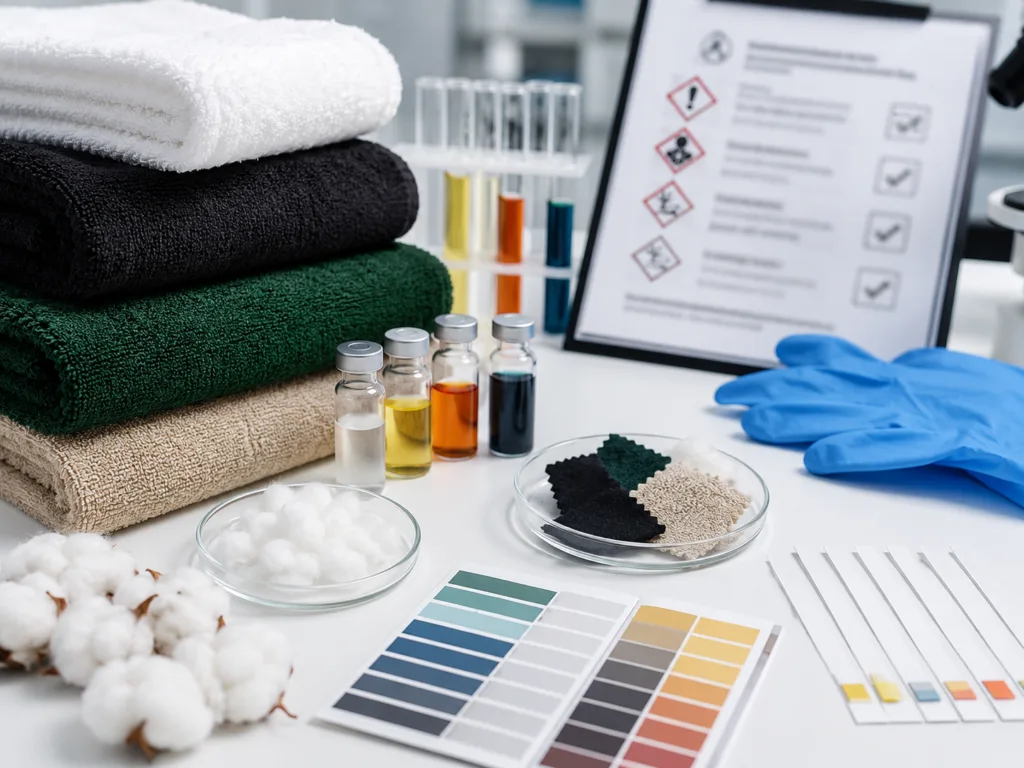
Many buyers think towels are low-risk because they are ordinary home textile products. In reality, towels can be chemically complex.
A white hotel towel and a custom black beach towel with printed logo are not the same risk profile. A natural cotton towel and a microfiber towel with silicone grip dots are not the same compliance case. A plain terry bath towel and a quick-dry gym towel with anti-odor finishing may require different levels of documentation.
The most common chemical concerns in towel sourcing include:
- Restricted azo dyes
- Formaldehyde
- Heavy metals
- Phthalates
- Certain flame retardants
- Alkylphenol ethoxylates
- PFAS in water-repellent or stain-resistant finishes
- Restricted colorants
- Organotin compounds
- Residues from finishing agents
- SVHC substances listed under the REACH Candidate List
The issue is not that every towel contains these substances. The issue is that buyers need a supplier who knows where the risk may come from and how to prevent it before bulk production.
A good supplier does not wait for the buyer to discover a problem after shipment. A good supplier asks questions early: target market, intended use, fiber composition, color, printing technique, logo method, packaging type, and testing requirements.
4. The Buyer’s Real Risk: Soft Handfeel Can Hide Complex Chemistry
In towel sourcing, “softness” is one of the most requested qualities. Buyers ask for a plush handfeel, hotel-grade touch, spa softness, or luxury cotton texture. But softness is not just a physical result. It may also be influenced by finishing.
This matters because some finishing processes can affect absorbency, durability, linting, colorfastness, and chemical safety. A towel can feel soft during sample evaluation but perform poorly after repeated washing. Or it can pass visual inspection but still fail a chemical requirement if the wrong dye or finishing agent was used.
European buyers should be careful with suppliers who focus only on handfeel and price. The better question is not simply:
“Can you make it softer?”
The better question is:
“How do you achieve softness, and can that finishing process meet our compliance requirements?”
A buyer-friendly way to evaluate softness
A mature towel supplier should be able to discuss:
- Yarn quality
- Cotton type
- Weaving density
- Pile height
- Washing process
- Softener control
- Absorbency impact
- Colorfastness after washing
- Whether the finishing process affects REACH or buyer-specific requirements
Softness should never be separated from performance and compliance.
5. Which Towel Types Need Stronger Compliance Review
Not all towels need the same level of compliance discussion. European buyers should classify towel orders by risk level before sampling.
Lower-risk towel projects
These are usually easier to manage:
- White cotton hotel towels
- Plain undyed cotton towels
- Simple terry bath towels
- Standard hand towels
- Basic washcloths
- Towels without logo decoration
Even for these products, buyers should still ask for fiber composition, test reports, and production consistency.
Medium-risk towel projects
These need more review:
- Dyed towels
- Dark color towels
- Retail packaged towel sets
- Embroidered logo towels
- Yarn-dyed stripe towels
- Jacquard logo towels
- Custom color bath towels
- Beach towels with larger color areas
Here, colorfastness, dye control, and actual color matching become important.
Higher-risk towel projects
These require stronger supplier control:
- Printed beach towels
- Microfiber sports towels
- Anti-slip yoga towels
- Quick-dry towels with special finishing
- Towels with anti-bacterial treatment
- Towels with silicone dots
- Towels using recycled fibers
- Baby towels
- Towels for wellness, spa, or skin-sensitive use
- Promotional towels with PVC-like printing
- Towels with water-repellent or stain-resistant finishing
These products often involve additional chemical inputs beyond basic cotton dyeing.
6. What European Buyers Should Ask Before Sampling
The best time to discuss REACH compliance is before sampling, not after production.
Many problems happen because buyers treat testing as the last step. They approve a sample based on color, texture, logo, and packaging. Then, after bulk goods are produced, they ask for compliance documents. If the report does not match the actual production, or if one component was changed, the buyer may face delays, re-testing, rework, shipment holds, or retail rejection.
Before sampling, European buyers should ask:
- What is the exact fiber composition?
- Is the towel dyed, bleached, printed, embroidered, or finished?
- Will the supplier use the same material for sample and bulk?
- Does the supplier have recent test reports for similar towels?
- Are reports available for the exact color or only for white fabric?
- Are logo decoration and packaging included in the compliance scope?
- Can the supplier follow the buyer’s RSL or brand chemical policy?
- If testing is needed, who pays and when should it be arranged?
- What happens if the buyer changes color, GSM, logo method, or finishing?
- Can the supplier provide batch consistency for repeat orders?
These questions help buyers identify whether a supplier is just selling towels or actually managing textile production.
7. Question 1: Can the Supplier Provide Recent REACH or SVHC Test Reports?
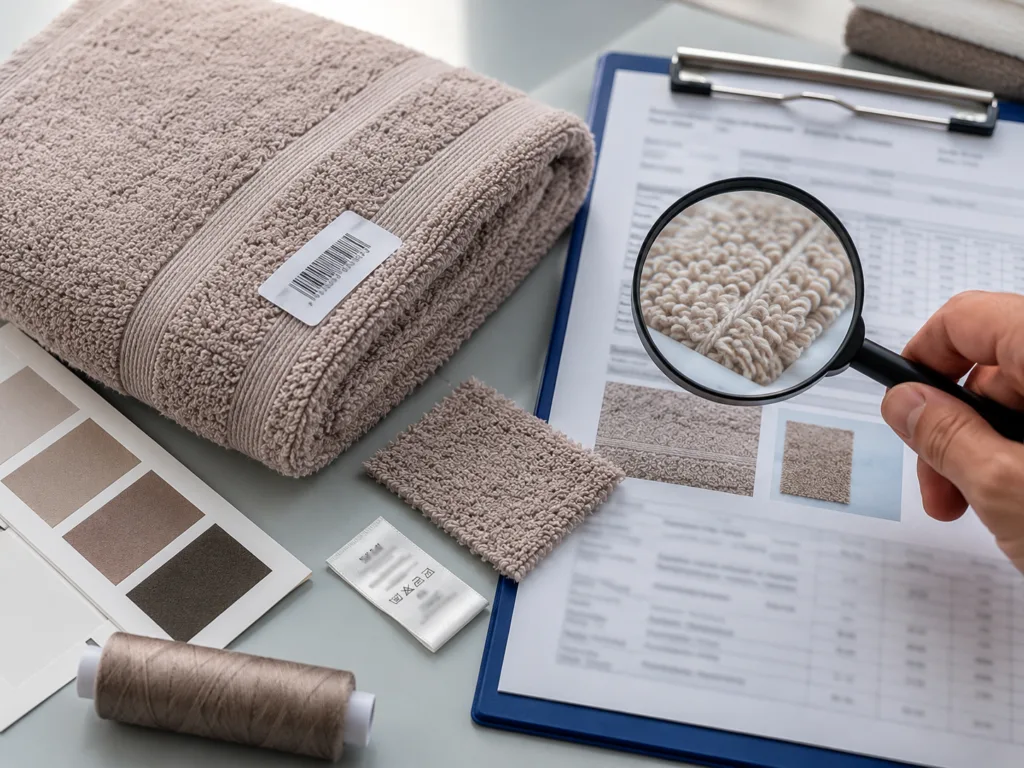
The first question European buyers should ask is simple:
Can you provide recent REACH or SVHC test reports for similar towel products?
A serious supplier should understand what the buyer is asking. They may not always have a report for the exact towel specification before the project starts, but they should know what type of report is relevant and when new testing may be needed.
Buyers should review:
- Testing laboratory name
- Report date
- Product description
- Material composition
- Color tested
- Test items
- Sample photos
- Whether the tested item matches the offered towel
- Whether the report is still relevant for current production
A report for a different product should not be treated as full proof. For example, a report for a white cotton bath towel does not automatically cover a dark green embroidered towel set with printed packaging.
H5 Buyer warning
If a supplier sends an old report with unclear product description, missing sample photos, or a product name that does not match the quotation, the buyer should ask for clarification.
H6 Practical note
A test report is useful only when it is connected to the actual material, color, process, and order being produced.
8. Question 2: Does the Test Report Match the Actual Towel Order?
This is where many buyers make mistakes. They ask for “a REACH report,” receive a PDF, and file it away without checking whether it matches the product.
For textile towels, a compliance document should be reviewed against the actual order details:
- Is it cotton, bamboo, microfiber, linen blend, or recycled fiber?
- Is the GSM the same or similar?
- Is the towel dyed or undyed?
- Is the tested color the same as the order color?
- Is the logo method included?
- Is the towel printed, jacquard woven, or embroidered?
- Does the report cover the finished product or only raw fabric?
- Does the packaging contain plastic, ink, coating, or adhesive?
This matters because towel customization often changes the risk profile. A buyer may start with a plain cotton towel, then add a silicone logo, color border, embroidery, paper belly band, polybag, barcode label, and retail gift box. Each added element may require review.
A professional supplier should not simply say “covered.” They should explain what is covered and what may require additional testing.
9. Question 3: Are Different Colors Tested Separately?
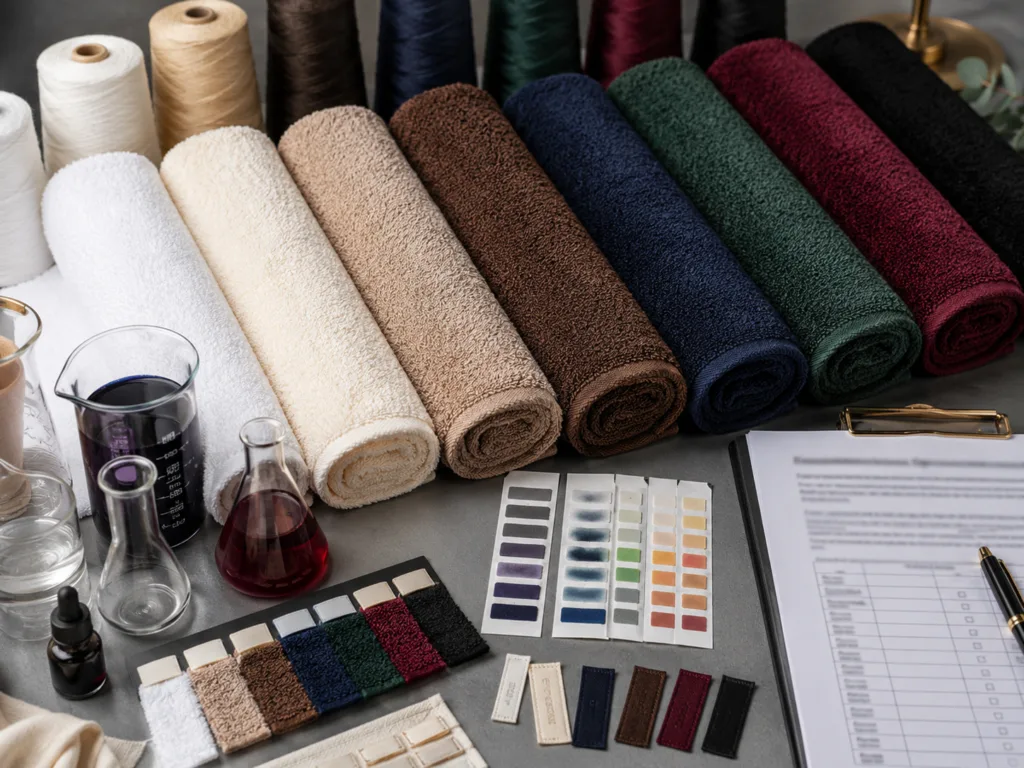
Color is one of the biggest variables in towel compliance.
European buyers often request custom Pantone colors for hotel groups, retail collections, resort branding, private labels, sports clubs, or promotional campaigns. But chemical risk can vary between white, beige, navy, black, red, green, and neon colors.
Dark colors and bright colors may require different dye formulas. Printed towels may involve pigments and binders. Yarn-dyed towels may involve different batches of dyed yarn. Even if the base material is the same, the color process can change the compliance picture.
Buyers should ask:
- Has this color family been tested before?
- Is the report for the same color or only for similar fabric?
- Are dark colors tested separately?
- Does the dyeing mill follow restricted substance controls?
- Can the supplier control colorfastness to washing, rubbing, and perspiration?
- Can the supplier maintain color consistency across bulk production?
For European buyers selling towel collections across multiple colors, the safest approach is to plan testing by risk category. Not every shade may need separate testing, but high-risk colors should not be ignored.
10. Question 4: Are Logo, Printing, Embroidery, Labels, and Packaging Included?
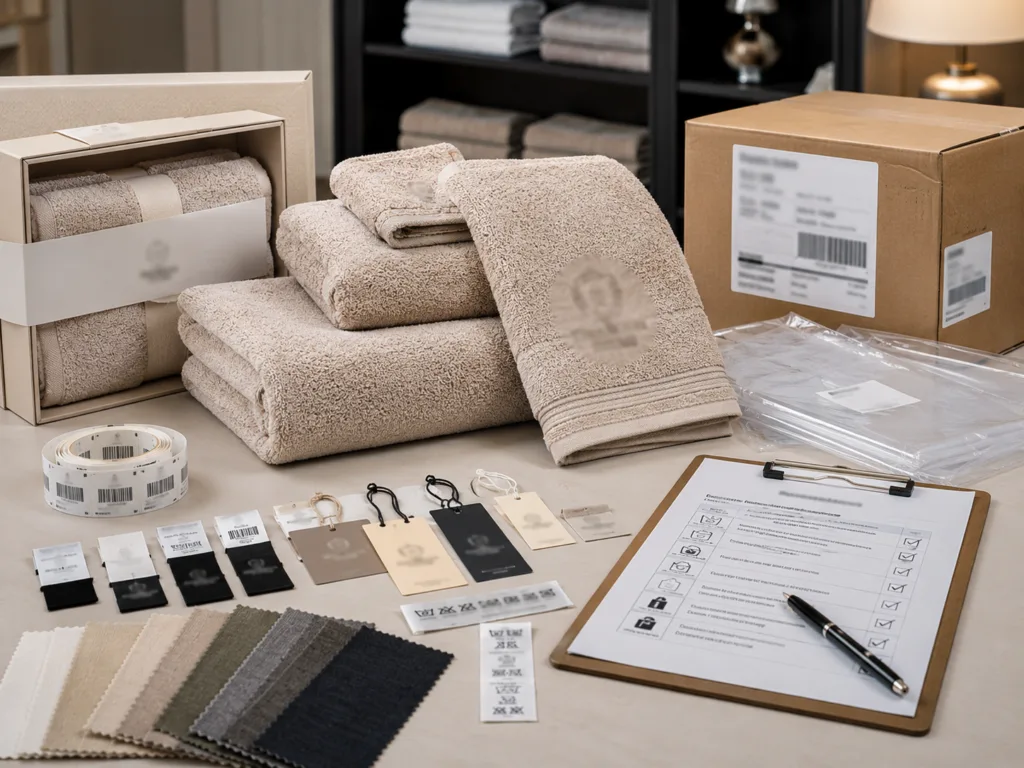
Custom towels are rarely just towels.
A finished private label towel order may include:
- Embroidered logo
- Jacquard woven logo
- Printed logo
- Heat transfer label
- Woven label
- Washing label
- Hang tag
- Paper belly band
- Barcode sticker
- Polybag
- Gift box
- Carton label
Each component can introduce different materials.
Embroidery thread may be polyester or rayon. Printing may involve pigment paste or silicone ink. Labels may contain ink, adhesive, coating, or synthetic fiber. Packaging may contain plasticizers, printing ink, lamination, or recycled paper.
European buyers should ask suppliers whether the compliance review includes the full finished product or only the towel body.
This is especially important for:
- Retail towel sets
- Promotional towels
- Hotel branded towels
- Spa gift towels
- Baby towel gift boxes
- Sports and yoga towels
- E-commerce packaged towel products
A supplier with real export experience will understand that European buyers do not only sell fabric. They sell a finished consumer product.
11. Question 5: How Does the Supplier Control Dyeing and Finishing Chemicals?
A test report is evidence. Process control is prevention.
European buyers should not only ask for final testing. They should ask how the supplier controls chemical input during production.
Important questions include:
- Does the supplier work with stable dyeing mills?
- Are restricted substances controlled before production?
- Can the supplier avoid high-risk dyes or finishing agents?
- Is there a chemical approval process for new colors or treatments?
- Are finishing agents selected according to buyer requirements?
- Can the supplier support low-formaldehyde or formaldehyde-free finishing where needed?
- Can the supplier avoid PFAS-based finishing if the buyer requires it?
- Does the supplier keep production records for repeat orders?
This is where mature buyers can separate professional suppliers from low-price vendors.
A low-price vendor may only answer after the buyer asks. A professional supplier will raise risk points before the order becomes expensive.
For example, if a buyer requests a quick-dry gym towel with anti-bacterial finishing for the EU market, the supplier should immediately discuss compliance, labeling, performance testing, and whether the claim can be supported. If a buyer requests water-repellent beach towels, the supplier should discuss PFAS concerns and alternative finishing options.
12. Question 6: Can the Supplier Support OEKO-TEX, Buyer RSL, or Brand-Specific Standards?
REACH is not the only chemical safety topic in European towel sourcing.
Many European buyers also ask for:
- OEKO-TEX support
- Buyer RSL compliance
- Brand-specific chemical restrictions
- Retailer testing protocols
- Labelling requirements
- Packaging compliance
- Sustainability documentation
- Recycled content verification
- Organic cotton certificates where applicable
OEKO-TEX is not the same as REACH, but it can be useful supporting evidence for textile chemical safety. Some buyers also have their own RSL, which may be stricter or more detailed than general market requirements.
A strong towel supplier should be able to work with the buyer’s compliance checklist and confirm what is feasible before quotation.
This matters for larger buyers because they are not only buying products. They are managing risk across retail channels, distributors, warehouses, customs, brand reputation, and repeat orders.
If a supplier cannot read or follow a buyer’s compliance document, the project may become risky even if the price looks attractive.
13. Question 7: What Happens If Material, Color, GSM, or Finishing Changes?
In towel manufacturing, small changes can have big compliance implications.
A buyer may approve a 500 GSM cotton towel sample, then later request 600 GSM. They may change from white to chocolate brown. They may switch from embroidery to silicone print. They may add a retail paper band or change the polybag. They may ask for quick-dry finishing or antibacterial treatment.
Each change should trigger a review.
European buyers should ask suppliers:
- Does this change affect the existing test report?
- Does the new color need additional review?
- Does the new logo method introduce new chemical materials?
- Does the new finishing affect absorbency or skin-contact safety?
- Does the new packaging need to be checked?
- Will the sample and bulk use the same process?
A reliable supplier will not pretend that every change is harmless. Instead, they will explain which changes are low risk and which changes may require confirmation.
This protects both sides. The buyer avoids market risk. The supplier avoids disputes after production.
14. How Mature Buyers Evaluate a REACH-Compliant Towel Supplier
Large buyers do not choose towel suppliers only by unit price.
They evaluate the full sourcing system:
- Can the supplier understand EU market requirements?
- Can the supplier communicate clearly before sampling?
- Can the supplier match fabric, color, GSM, and logo method?
- Can the supplier provide realistic MOQ and lead time?
- Can the supplier support compliance documentation?
- Can the supplier manage testing before bulk production?
- Can the supplier keep quality consistent across repeat orders?
- Can the supplier handle packaging, labels, cartons, and export documents?
- Can the supplier respond when the buyer’s compliance team asks detailed questions?
This is especially important for hotel groups, retail chains, spa brands, wellness companies, gift suppliers, and importers who buy in large quantities.
For these buyers, the cheapest towel is rarely the safest choice. A failed shipment, delayed retail launch, rejected product, or compliance dispute can cost far more than the savings from a lower unit price.
The right supplier helps the buyer reduce uncertainty.
15. Why Compliance Should Be Discussed Before Bulk Production
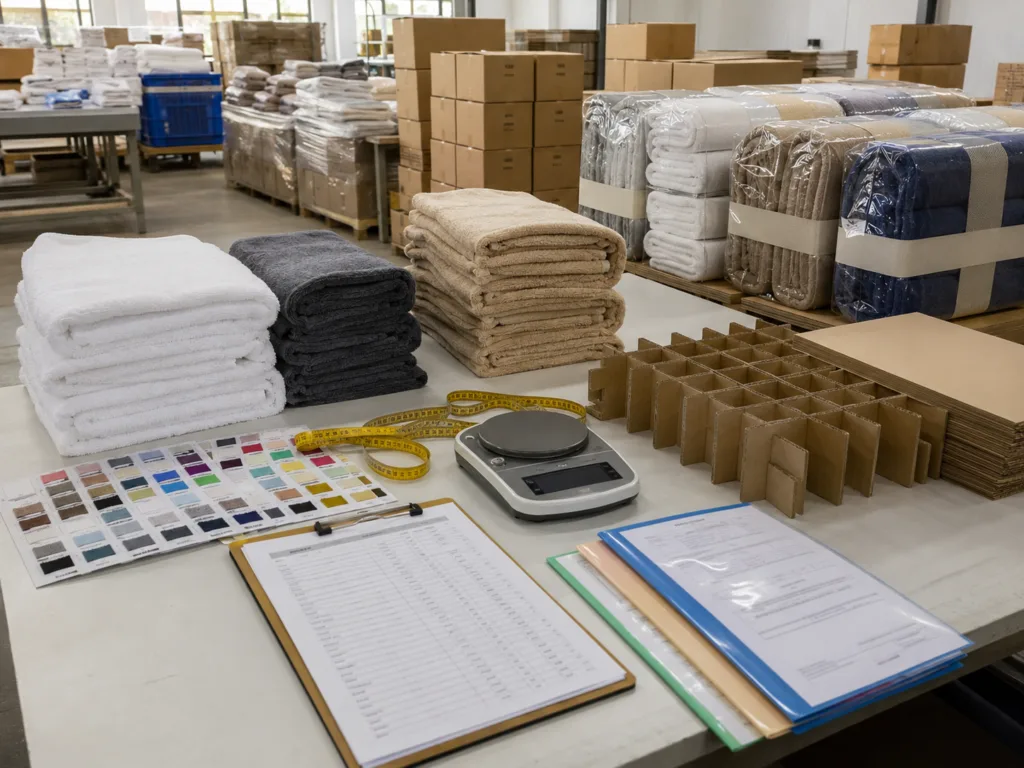
The worst time to discover a compliance problem is after bulk production.
At that point, the buyer may already have approved artwork, paid deposit, booked marketing campaigns, arranged warehouse space, and planned retail delivery. If the finished towels need re-testing or fail chemical requirements, the cost can be significant.
The better workflow is:
- Confirm target market and sales channel.
- Confirm intended use.
- Confirm material composition.
- Confirm towel construction and GSM.
- Confirm color and logo method.
- Confirm packaging and label requirements.
- Review available supplier reports.
- Decide whether new testing is needed.
- Make samples using the intended bulk process.
- Approve sample, testing plan, packaging, and production details before bulk order.
This workflow is especially useful for buyers placing large custom towel orders. It helps prevent miscommunication and makes production more predictable.
Compliance is not a final checkbox. It is part of product development.
16. How Circe Towel Supports European Bulk Towel Buyers
Circe Towel works with international buyers who need custom towel sourcing with practical production support, clear communication, and export-oriented documentation thinking.
For European buyers, our goal is not only to supply towels. Our goal is to help buyers make better sourcing decisions before production starts.
We support towel projects such as:
- Hotel bath towels
- Spa towels
- Beach towels
- Gym towels
- Yoga towels
- Hand towels
- Washcloths
- Private label towel sets
- Promotional towels
- Retail packaged towel collections
For custom towel projects, we help buyers review:
- Cotton or blended material options
- GSM and towel structure
- Weaving method
- Custom size
- Color direction
- Logo technique
- Packaging method
- MOQ feasibility
- Sample plan
- Bulk lead time
- Compliance documentation needs
When a European buyer asks for REACH compliance, we do not treat it as a simple yes-or-no question. We first look at the actual towel specification: material, color, process, logo, finishing, and packaging. This helps determine whether existing documents are relevant or whether project-specific testing should be arranged.
For large orders, this early review is valuable. It reduces the risk of choosing the wrong material, the wrong dyeing method, the wrong logo process, or the wrong packaging solution.
Why this matters for serious buyers
A mature buyer does not need a supplier who only says “yes.” A mature buyer needs a supplier who can say:
- This option is suitable.
- This option needs testing.
- This color may require extra review.
- This logo method is safer for your use.
- This packaging is more appropriate for your sales channel.
- This MOQ is realistic.
- This production timeline is achievable.
That is the type of sourcing support Circe Towel aims to provide.
If you are sourcing custom towels for the European market, especially for hotels, spas, retailers, importers, wellness brands, or promotional programs, REACH compliance should be discussed at the beginning of the project. With the right supplier, compliance does not slow down sourcing. It makes bulk production safer, clearer, and more reliable.
17. FAQ: REACH Compliance for Textile Towels
1. Does REACH apply to textile towels sold in Europe?
Yes. Textile towels are consumer products, and chemical substances used in dyeing, finishing, printing, labels, or packaging may be subject to REACH restrictions or SVHC communication requirements. European buyers should ask suppliers for relevant documentation before bulk production.
2. Is an OEKO-TEX certificate the same as REACH compliance?
No. OEKO-TEX and REACH are different systems. OEKO-TEX can be useful supporting evidence for textile chemical safety, but buyers should still check whether the actual towel order, color, logo method, and packaging meet the required EU or buyer-specific standards.
3. Do all towel colors need separate REACH testing?
Not always, but color can affect chemical risk. Dark colors, bright colors, special dyeing, printing, and customized finishes may require additional review. Buyers should ask whether the supplier’s test report covers the actual color or only a different towel sample.
4. What should European buyers ask before placing a bulk towel order?
Buyers should ask about fiber composition, dyeing process, finishing chemicals, REACH or SVHC reports, OEKO-TEX support, logo decoration, packaging materials, colorfastness, testing scope, and whether any change in material, color, GSM, or finishing requires a new compliance review.
Final Buyer Checklist
Before confirming a bulk towel order for the European market, ask your supplier:
- Can you provide recent REACH or SVHC test reports?
- Does the report match this exact towel order?
- Are different colors reviewed separately?
- Are logo, labels, and packaging included?
- How do you control dyeing and finishing chemicals?
- Can you support OEKO-TEX or buyer RSL requirements?
- What happens if we change material, GSM, color, logo, or finishing?
- Can samples be made using the intended bulk production process?
- Can you support repeat orders with consistent quality?
- Can you communicate compliance risks before production?
For European buyers, the strongest towel supplier is not only the one who offers a competitive price. It is the one who can manage product quality, customization, compliance, and bulk production risk together.
That is the difference between buying towels and building a reliable towel supply chain.