
For B2B towel buyers, comparing China vs Turkey towel manufacturers is not a simple question of “which country is cheaper?” or “which country makes better towels?” That kind of comparison is too shallow for serious importers, hotel groups, retail chains, spa suppliers, gym operators and wholesale distributors.
The real question is this:
Which sourcing country can support your required towel quality, target price, compliance needs, packaging plan, delivery schedule and long-term reorder strategy?
China and Turkey are both strong towel manufacturing bases, but they serve different buying priorities. Turkey has a strong reputation for cotton towels, peshtemal towels, bathrobes and premium home textile programs, especially for European buyers. China, on the other hand, offers broader product coverage, stronger customization flexibility, competitive bulk pricing, private label packaging support and mature export supply chain integration.
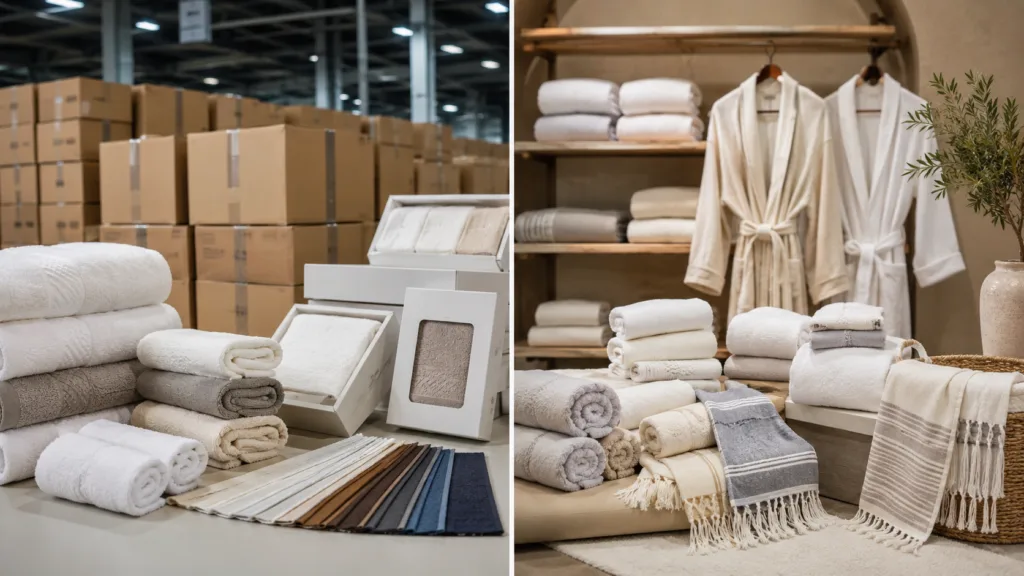
If you are buying towels for retail shelves, hotels, gyms, spas, salons, car care brands, promotional channels or wholesale distribution, the better choice depends on your product type, GSM, material, order quantity, inspection standard and market positioning.
This guide compares China and Turkey towel manufacturers from a practical B2B sourcing perspective: cost, quality, GSM, absorbency, applications, sizes, packaging, lead time, inspection risks and supplier selection.
1. China vs Turkey Towel Manufacturers: A Quick Overview
Turkey is widely recognized for cotton towels, especially Turkish cotton towels, peshtemal towels, bathrobes and hotel textile products. Many buyers associate Turkish towels with softness, long-staple cotton, absorbency and a premium Mediterranean lifestyle image. For European retailers and boutique hotel buyers, Turkey also has a geographic advantage because shipping distances are shorter than sourcing from Asia.
China’s towel manufacturing advantage is different. China is not only a cotton towel production base. It also has a much wider range of towel categories, including hotel towels, bath towels, beach towels, gym towels, microfiber towels, car drying towels, kids towels, spa towels, promotional towels, gift towel sets and private label retail towel programs.
For buyers who need more than a basic towel, China often becomes more competitive. This is especially true when the order involves custom GSM, special sizes, logo embroidery, jacquard patterns, reactive printing, woven labels, care labels, paper belly bands, polybags, barcode stickers, retail boxes, export cartons or multi-SKU packaging.
In short:
Turkey is strong when the buyer wants premium cotton towel positioning and faster access to Europe. China is strong when the buyer wants product variety, cost control, customization, packaging integration and scalable bulk production.
2. Cost Comparison: Factory Price Is Not the Final Cost

Many buyers make the mistake of comparing only the unit price. This is dangerous. A towel quoted at USD 2.80 and another towel quoted at USD 3.20 may not be comparable at all.
Before comparing China and Turkey towel manufacturers, buyers should confirm:
- Material composition
- Yarn quality
- GSM
- Finished size
- Towel weight
- Dyeing method
- Logo method
- Packaging requirement
- MOQ
- Inspection standard
- Shipping term
- Import duty
- Inland delivery cost
- Defect allowance
- Reorder price stability
A 70 × 140 cm bath towel in 400gsm and a 70 × 140 cm bath towel in 600gsm are two very different products. A yarn-dyed jacquard beach towel and a printed microfiber beach towel cannot be judged by the same pricing logic. A hotel towel packed in bulk cartons and a retail towel set packed with a paper band, hang tag, barcode label and gift box also have different cost structures.
China Cost Advantages
China towel manufacturers are often more competitive for bulk orders, multi-SKU programs and private label projects. The advantage is not only labor cost. It is supply chain density.
In China, a towel supplier can often coordinate:
- Towel weaving
- Dyeing
- Cutting and sewing
- Embroidery
- Jacquard weaving
- Printing
- Woven labels
- Care labels
- Hang tags
- Paper bands
- Retail boxes
- Polybags
- Carton labels
- Export cartons
- Pallet packing
- Pre-shipment inspection
This matters for B2B buyers because packaging and labeling can become expensive when handled separately. For retail brands, Amazon sellers, hotel suppliers and wholesale distributors, the ability to integrate production and packaging under one supplier can reduce communication cost, sampling time and quality mismatch.
China is also strong for cost engineering. A good Chinese towel manufacturer can help buyers adjust GSM, yarn, size, logo method and packaging to hit a target price without destroying the product’s market value.
For example, if a buyer wants a gym towel with fast-dry performance and a competitive wholesale price, a Chinese supplier may suggest a microfiber or cotton-polyester blended option instead of a heavy cotton terry towel. If a buyer wants a hotel towel with a premium feel but controlled cost, the supplier may recommend a 500–550gsm combed cotton towel instead of jumping directly to 700gsm.
Turkey Cost Advantages
Turkey is not always cheaper than China, but it can be cost-effective for certain European buyers when total landed cost is considered. For buyers importing into Europe, Turkey’s proximity can reduce shipping time and freight uncertainty. In some cases, customs treatment under EU–Türkiye trade arrangements can also make Turkey more attractive than a lower FOB price from Asia.
Turkey is particularly strong when the product is a cotton towel, peshtemal, bathrobe or premium home textile item with a clear “Made in Turkey” marketing value. If the buyer’s retail strategy depends on Turkish cotton storytelling, a slightly higher unit price may still make commercial sense.
The key point is this: China may offer a stronger factory price and broader customization options, while Turkey may offer stronger regional logistics advantages for Europe and a premium cotton perception.
3. Quality Comparison: Country of Origin Is Not a Quality Standard
A common mistake in towel sourcing is assuming that Turkish towels are always premium and Chinese towels are always low-cost. This is not accurate.
Turkey has strong quality recognition in cotton towels, especially for Turkish cotton, peshtemal towels and hotel textiles. However, China also produces a wide range of towel qualities, from entry-level promotional towels to premium hotel towels, bamboo towels, organic cotton towels, microfiber towels and luxury retail towel sets.
For serious buyers, quality should be defined by technical specifications, not by country image.
A reliable towel specification should include:
- Material composition
- Yarn type
- GSM
- Finished size
- Weight per piece
- Weaving construction
- Pile height
- Absorbency requirement
- Colorfastness standard
- Shrinkage tolerance
- Lint control
- Edge stitching method
- Logo method
- Packaging details
- Inspection criteria
If a supplier only says “high quality towel” but cannot explain GSM, yarn, absorbency, shrinkage or colorfastness, the buyer should be careful.
4. Material Comparison: Cotton, Turkish Cotton, Bamboo and Microfiber
Material choice has a direct impact on cost, absorbency, softness, drying speed, weight, durability and application.
Cotton Towels
Cotton remains the most common material for bath towels, hotel towels, spa towels and home towels. It is soft, absorbent and familiar to end users. Cotton towels are suitable for hotels, resorts, gyms, salons, spas, retail stores and promotional gift sets.
Common cotton towel options include:
- Carded cotton
- Combed cotton
- Ring-spun cotton
- Zero-twist cotton
- Organic cotton
- Long-staple cotton
- Turkish cotton
Combed cotton is generally smoother and cleaner because shorter fibers and impurities are removed during processing. Ring-spun cotton can offer better strength and softness. Zero-twist cotton feels fluffy and soft, but may not always be the best choice for high-frequency commercial laundering.
Turkish Cotton Towels
Turkish cotton is valued for its long fibers, soft touch and absorbent performance. It is especially popular in bath towels, peshtemal towels, spa towels and boutique hotel towels.
For buyers selling premium lifestyle products, “Turkish cotton” can be a marketing advantage. However, it should still be verified with actual specifications. Buyers should ask about yarn count, GSM, towel weight, shrinkage rate, dyeing standard and test reports instead of relying only on the name.
Bamboo Towels
Bamboo towels are often marketed as soft, smooth and eco-conscious. They are suitable for spa, beauty, baby, wellness and premium home textile markets. However, bamboo towels can cost more than standard cotton towels and may require more careful communication about material composition and labeling.
Microfiber Towels
Microfiber towels are widely used for gyms, sports, travel, cleaning, car care and fast-dry applications. They dry faster than cotton towels and can be made lightweight, compact and highly absorbent.
China is particularly strong in microfiber towel manufacturing, including:
- Gym towels
- Sports towels
- Yoga towels
- Travel towels
- Cooling towels
- Car drying towels
- Twisted loop microfiber towels
- Cleaning towels
If the buyer’s market is fitness, car care, outdoor, travel or promotional products, China often offers more options than Turkey.
5. GSM Comparison: Why Towel Weight Changes Everything
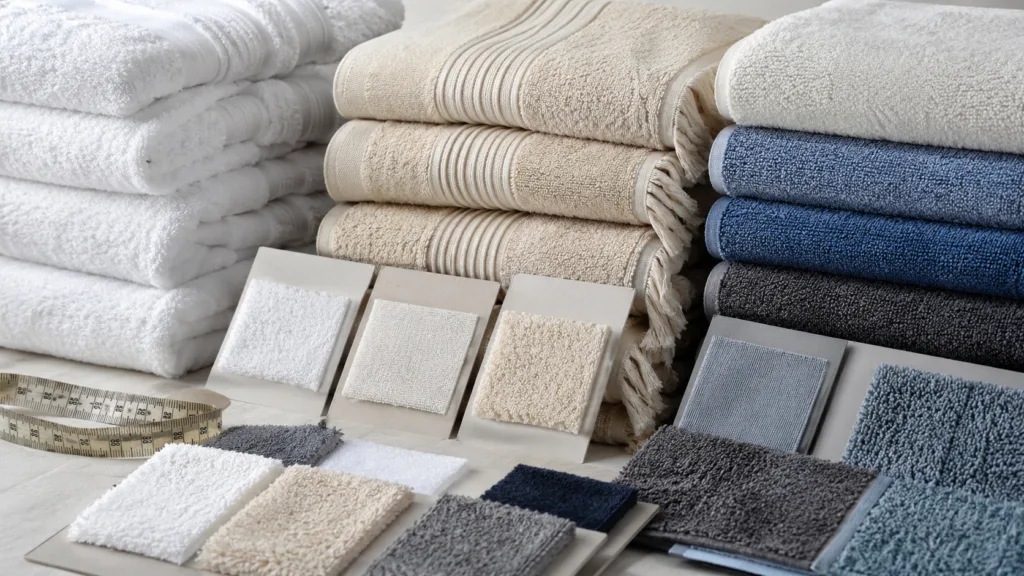
GSM means grams per square meter. It is one of the most important specifications in towel manufacturing.
Higher GSM usually means a thicker, heavier and more luxurious towel. Lower GSM usually means a lighter, faster-drying and more economical towel. But higher GSM is not always better. The right GSM depends on the application.
Common GSM Ranges for B2B Towels
300–400gsm:
Lightweight towels, gym towels, promotional towels, travel towels, budget hotel towels and fast-dry use.
400–500gsm:
Commercial bath towels, fitness towels, salon towels, spa towels and mid-range hotel towels.
500–600gsm:
Good-quality hotel towels, retail bath towels, resort towels and private label towel sets.
600–700gsm:
Premium hotel towels, luxury bath towels and high-end retail towels.
700gsm+:
Luxury towels with a heavy hand feel, but not always ideal for every commercial buyer because they cost more, dry slower and increase shipping weight.
For bulk orders, GSM affects not only the towel price but also carton volume, total shipment weight, drying performance and laundry cost. A hotel buyer may love a 700gsm towel in the showroom, but the housekeeping team may prefer a 500–550gsm towel that dries faster and survives repeated washing.
This is where an experienced supplier becomes valuable. A reliable manufacturer should not simply push the heaviest towel. They should recommend the right GSM based on application, budget, washing frequency and target market.
6. Absorbency, Softness and Durability: What Buyers Should Really Test
A towel must look good, but appearance is not enough. For B2B buyers, especially hotels, gyms, spas and wholesalers, performance after repeated use matters more than first-touch softness.
Key performance factors include:
Absorbency
Absorbency depends on fiber type, yarn quality, pile structure, finishing process and whether softeners were overused. Some towels feel very soft in the sample stage because of heavy softening treatment, but they may absorb poorly. This is a common bulk order risk.
Buyers should test how quickly the towel absorbs water and whether absorbency remains acceptable after several washes.
Softness
Softness is important for hotels, spas, retail bath towels and baby towels. However, softness must be balanced with durability. A towel that feels extremely fluffy but loses pile quickly after laundering is not suitable for commercial use.
Lint Control
Linting is a major complaint for dark towels, hotel towels, salon towels and car care towels. Poor yarn quality, loose pile and inadequate finishing can cause excessive lint.
For large orders, buyers should request pre-production samples and wash-test them before approving bulk production.
Shrinkage
Cotton towels naturally shrink after washing. A controlled shrinkage rate is acceptable, but excessive shrinkage can create customer complaints, especially for retail towel sets and hotel programs where size consistency matters.
Colorfastness
Color bleeding is one of the most damaging quality problems in bulk towel orders. Dark towels, reactive-dyed towels and colorful beach towels should be tested carefully. For European and North American buyers, colorfastness to washing, rubbing and chlorine exposure may be important depending on the application.
7. Application Scenarios: Which Country Fits Which Buyer?

Different towel categories require different sourcing logic. A supplier that is good at peshtemal towels may not be the best choice for microfiber car drying towels. A factory that produces hotel towels may not be ideal for full retail packaging.
Hotel Towels
Hotel buyers care about softness, absorbency, whiteness, GSM, durability, shrinkage, edge stitching and laundry performance.
Turkey is strong for premium cotton hotel towels and bathrobes. China is strong for cost-controlled hotel towel programs, custom sizes, logo embroidery, large production runs and mixed towel sets including bath towels, hand towels, face towels, bath mats and pool towels.
For hotels, the best supplier is the one that can provide stable reorders and consistent towel weight, not just a beautiful first sample.
Gym and Fitness Towels
Gym towels usually need to be durable, fast-drying, cost-effective and easy to wash in bulk. Common choices include cotton gym towels, microfiber gym towels and blended towels.
China has a strong advantage in gym towels because of flexible material options, competitive pricing and lower MOQ possibilities for certain custom programs.
Spa and Salon Towels
Spa and salon towels need softness, color consistency, absorbency and repeated washing performance. Dark colors must be tested carefully because color bleeding and fading can cause operational problems.
Both China and Turkey can supply spa towels, but China may offer more packaging and private label flexibility for spa brands.
Beach Towels
Beach towels may involve yarn-dyed jacquard, reactive printing, velour finishing, oversized dimensions and retail packaging.
China is strong in printed beach towels, custom patterns, promotional beach towels and private label retail packaging. Turkey is strong if the buyer wants peshtemal-style beach towels or a Turkish cotton positioning.
Promotional Towels
For promotional towels, price, logo visibility, MOQ and delivery schedule are usually more important than luxury hand feel. China is usually the better fit for promotional towel programs because it offers more logo methods, packaging options and cost control.
Car Care Towels
Car drying towels, twisted loop microfiber towels and detailing towels are usually more closely associated with China’s microfiber supply chain. Buyers need to check GSM, pile structure, edge type, absorbency, lint control and scratch-free performance.
8. Size Comparison: Standard Sizes and Custom Programs
Towel size varies by market and application. Buyers should confirm finished size after washing, not only cutting size before production.
Common towel sizes include:
- Face towel: 30 × 30 cm, 30 × 50 cm
- Hand towel: 40 × 70 cm, 50 × 90 cm
- Bath towel: 70 × 140 cm, 76 × 152 cm
- Bath sheet: 90 × 150 cm, 100 × 180 cm
- Hotel bath mat: 50 × 70 cm
- Gym towel: 30 × 100 cm, 40 × 80 cm, 50 × 100 cm
- Beach towel: 80 × 160 cm, 90 × 170 cm, 100 × 180 cm
- Spa towel: customized by treatment use
- Car drying towel: 40 × 40 cm, 50 × 80 cm, 60 × 90 cm
China is especially strong when buyers need non-standard sizes, mixed-size towel sets or private label packaging by SKU. Turkey is also capable of custom sizing, but buyers should compare MOQ, sampling time and price impact.
For retail buyers, size consistency matters because products must match packaging, shelf display and barcode data. For hotel buyers, size consistency matters because towel sets need to look uniform across rooms and departments.
9. Packaging Comparison: A Hidden Cost That Many Buyers Forget
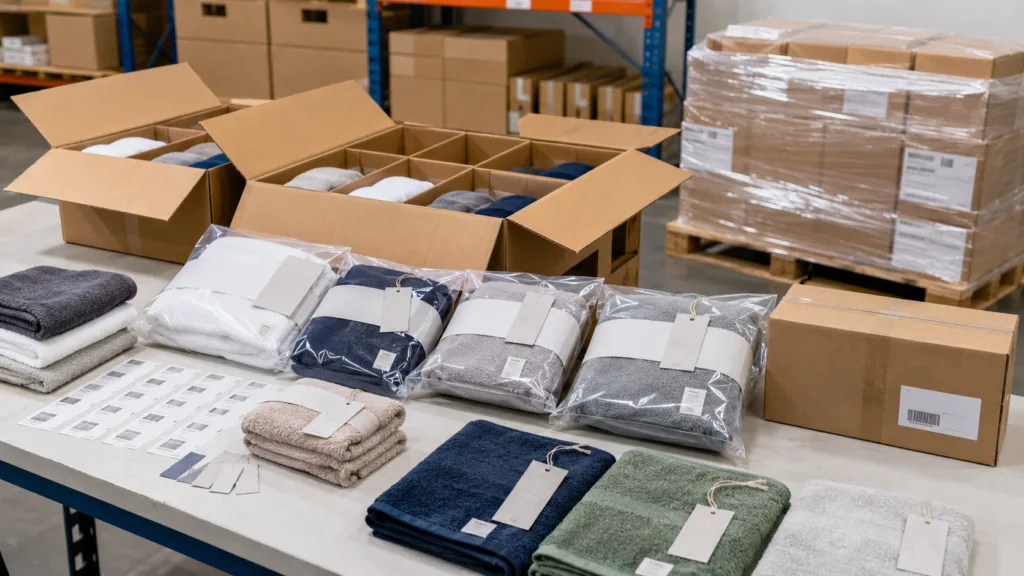
Packaging is often underestimated in towel sourcing. For B2B buyers, packaging is not decoration. It affects retail presentation, warehouse handling, barcode scanning, shipping protection and customer experience.
Common towel packaging options include:
- Bulk carton packing
- Individual polybag
- Recyclable paper band
- Hang tag
- Woven label
- Care label
- Barcode sticker
- Retail box
- Gift box
- Ribbon
- Kraft carton
- Pallet packing
- Custom shipping marks
China has a strong advantage in private label towel packaging because the packaging supply chain is highly developed. Buyers can often source towels, labels, paper bands, stickers, boxes and cartons through one coordinated supplier.
This is important for:
- Retail brands
- Amazon sellers
- Department stores
- Supermarket chains
- Corporate gift companies
- Hotel suppliers
- Wholesale distributors
Turkey can also provide packaging, especially for premium towel programs, but China may offer more flexibility and cost control for complex packaging combinations.
A serious buyer should always confirm packaging before bulk production, including:
- Carton size
- Carton weight
- Pieces per carton
- Inner packing method
- Barcode position
- Label material
- Warning label if required
- Country of origin marking
- Care instruction
- Recyclable packaging requirement
- Pallet loading plan
Poor packaging can damage a good towel order. Retail buyers should never leave packaging decisions until the end.
10. Lead Time Comparison: Sampling, Bulk Production and Shipping
Lead time should be divided into three parts: sample lead time, bulk production lead time and shipping time.
Sample Lead Time
For China towel manufacturers, stock samples can often be arranged quickly if the buyer accepts existing materials, colors and sizes. Custom samples take longer, especially when they involve special dyeing, jacquard patterns, embroidery, new size development or retail packaging.
For Turkey towel manufacturers, sample delivery to Europe may be faster because of shorter distance. For buyers in the EU, UK and nearby regions, this can be a real advantage.
However, sample speed alone should not decide the supplier. The bigger question is whether the sample can be repeated consistently in bulk production.
Bulk Production Lead Time
Bulk production lead time depends on:
- Order quantity
- Material availability
- Dyeing requirement
- Weaving schedule
- Logo method
- Packaging complexity
- Factory capacity
- Peak season
- Inspection arrangement
China is strong for scalable bulk production and multi-process coordination. Turkey is strong for established cotton towel programs, especially when serving European buyers.
For customized towel orders, buyers should avoid unrealistic deadlines. A rushed towel order can lead to shade variation, unstable weight, poor sewing, wet packing, linting issues or packaging mistakes.
Shipping Time
For European buyers, Turkey has a clear geographic advantage. Shorter shipping routes can reduce delivery uncertainty and make replenishment easier.
For North American buyers, the comparison is more complicated. Both China and Turkey require careful freight planning, customs clearance and duty calculation. China may still be more competitive for large-volume orders because of price, production capacity and established export routes.
For Australian buyers, China often has a stronger logistics advantage due to mature Asia-Pacific trade routes and supplier networks.
The best approach is to compare total landed cost and realistic delivery time, not only production time.
11. How to Inspect Bulk Towel Orders Before Shipment
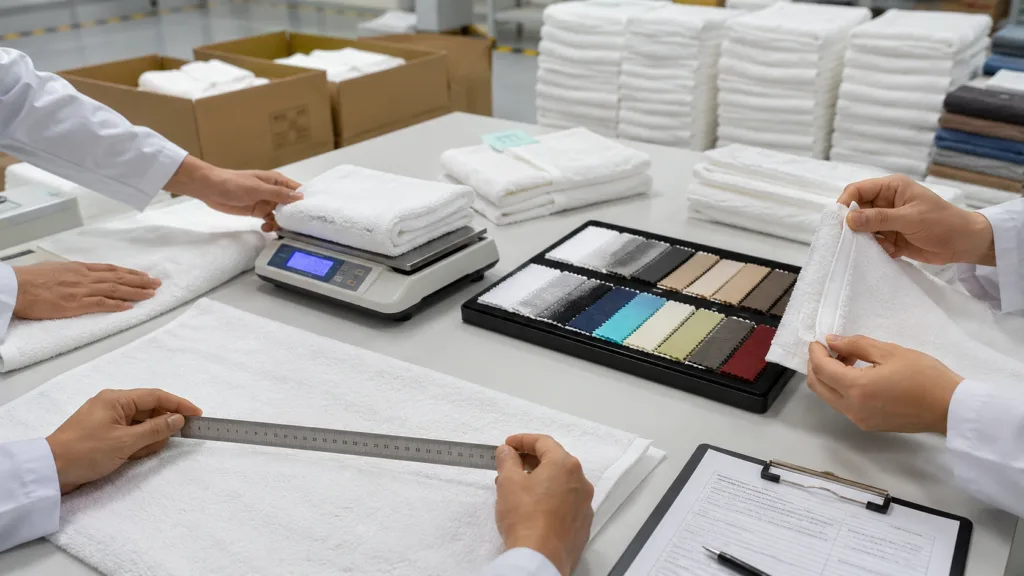
A professional towel buyer should never rely only on a nice sample. Bulk inspection is essential.
A good pre-shipment inspection should include:
Quantity Check
Confirm total quantity, carton count, SKU breakdown, color ratio and size ratio.
Size Measurement
Measure finished towel size from different cartons. Compare results with approved specifications and tolerance.
Weight and GSM Check
Check towel weight per piece and calculate whether it matches the approved GSM. Large weight variation may indicate unstable production.
Color Shade Check
Compare bulk towels with approved color samples under proper lighting. Check shade consistency between cartons and batches.
Absorbency Test
Test water absorption speed and surface wetting. Be cautious if towels feel very soft but repel water.
Stitching and Edge Check
Inspect hems, binding, loose threads, skipped stitches, broken seams and uneven edges.
Logo Inspection
Check embroidery, jacquard, printed logo or woven label placement. Make sure the logo is centered, stable and consistent.
Lint and Surface Check
Shake and rub towels to check linting. Inspect pile uniformity, pulled loops, stains, oil marks, holes and weaving defects.
Packing Check
Confirm polybags, labels, hang tags, barcode stickers, carton marks, carton strength and packing method.
Random Wash Test
For higher-value orders, buyers should arrange wash testing before shipment or before final approval. Wash testing helps identify shrinkage, color bleeding, linting and absorbency problems.
A reliable supplier should welcome inspection. If a supplier refuses reasonable QC requirements, that is a warning sign.
12. How to Avoid Bulk Quality Problems
Most towel quality problems are preventable if buyers control the process before production starts.
Here are practical steps:
Approve a Detailed Sample
Do not approve a sample only by photo. Confirm material, GSM, size, color, logo, edge, weight and packaging.
Create a Written Specification Sheet
Every bulk order should have a spec sheet. It should include size, GSM, material, weight, color, logo, label, packaging, carton details and inspection tolerance.
Confirm Color Standard
Use Pantone, lab dip or approved physical color swatch. Do not rely on screen color.
Test Before Bulk Production
For hotel, spa, salon and retail towels, wash testing is highly recommended. This is especially important for dark colors and high-GSM towels.
Control Packaging Early
Packaging should be sampled and approved before mass production. Barcode errors, label mistakes and carton mark problems can delay shipment.
Arrange Pre-Shipment Inspection
Inspection should be done when production is finished but before goods leave the factory.
Choose a Supplier With Export Experience
A factory may be good at production but weak in export documentation, packaging, labeling or communication. For B2B buyers, export experience matters.
13. When Should You Choose Turkey?
Turkey may be the better choice if:
- Your main market is Europe
- You need shorter regional delivery
- Your product is premium cotton towel or peshtemal
- “Made in Turkey” supports your brand story
- You focus on boutique hotels, spas or premium home textiles
- You prefer smaller regional replenishment cycles
- Your buyer values Turkish cotton positioning
Turkey is especially attractive for European brands that want a premium cotton image and shorter supply chain distance.
14. When Should You Choose China?
China may be the better choice if:
- You need competitive bulk pricing
- You want more towel categories
- You need microfiber, gym, car care or promotional towels
- You need custom size, GSM, color or logo
- You want private label packaging
- You are building a multi-SKU towel program
- You need retail-ready packaging and export cartons
- You want one supplier to coordinate production, branding and shipment
- You serve North America, Australia or global wholesale markets
China is especially suitable for importers, wholesalers, hotel suppliers, gym suppliers, promotional product companies and retail brands that need a balance of price, customization and production capacity.
15. Final Recommendation for B2B Towel Buyers
The China vs Turkey towel manufacturers comparison should not be reduced to “cheap vs premium.” That is not how professional sourcing works.
Turkey has a strong position in premium cotton towels, peshtemals, bathrobes and European regional supply. China has a stronger advantage in broad product range, flexible customization, private label packaging, cost engineering, microfiber categories and scalable bulk production.
For mature B2B buyers, the best supplier is not always the one with the lowest quotation. The best supplier is the one that can help you control quality, avoid bulk defects, meet your lead time, support your packaging needs and deliver stable reorders.
Before placing a large towel order, ask these questions:
- Is the material clearly specified?
- Is the GSM suitable for the application?
- Has the towel been wash-tested?
- Is absorbency acceptable after finishing?
- Is the color stable?
- Is the packaging approved?
- Is the supplier experienced with export orders?
- Can the supplier support inspection before shipment?
- Can the supplier repeat the same quality in the next order?
If you are sourcing custom towels for hotels, gyms, spas, retail brands, wholesalers or promotional channels, China remains one of the most practical sourcing choices for flexible development and large-scale production.
A reliable China towel manufacturer can help you develop the right towel, control the cost, prepare private label packaging, arrange quality inspection and support long-term bulk supply.
For serious buyers, that is what really matters.
FAQ
1. Are Turkish towel manufacturers better than Chinese towel manufacturers?
Not always. Turkish towel manufacturers are strong in premium cotton towels, peshtemals and bathrobes, especially for European buyers. Chinese towel manufacturers are stronger in product variety, customization, microfiber towels, private label packaging and cost control for bulk orders. The better choice depends on your towel type, market, MOQ, GSM, packaging and delivery schedule.
2. Is China cheaper than Turkey for bulk towel orders?
China is often more competitive for large-volume towel orders, especially when the project involves multiple SKUs, custom sizes, logo work and packaging. However, buyers should compare landed cost, not only factory price. Freight, duty, packaging, inspection and delivery time can change the final cost.
3. What GSM is best for hotel towels?
For most commercial hotel towels, 500–600gsm is a practical range because it balances softness, absorbency, durability and drying time. Luxury hotels may choose 600–700gsm or higher, but heavier towels cost more, dry slower and increase laundry cost. The best GSM depends on hotel positioning and washing frequency.
4. How can buyers avoid quality problems in bulk towel orders?
Buyers should approve a physical sample, confirm a detailed specification sheet, test absorbency and shrinkage, approve packaging before production, check color consistency and arrange pre-shipment inspection. The most common towel quality problems include size variation, low absorbency, color bleeding, linting, poor stitching, wrong labels and inconsistent GSM.
Reference Sources for Editorial Use
- EU Access2Markets: EU–Türkiye Customs Union
- U.S. International Trade Commission: HTS 6302 towel classification
- OEKO-TEX: STANDARD 100 textile safety standard
- European Commission: REACH Regulation
- ISO: ISO 6330 domestic washing and drying procedures for textile testing
- AATCC: TM61 Colorfastness to Laundering, Accelerated
- World Bank WITS: international merchandise trade and tariff data
- UN Comtrade: global trade statistics database
- Republic of Türkiye Ministry of Trade: home textiles sector information