
For bulk towel buyers, quality problems rarely stay small.
A towel that sheds slightly in a sample may create hundreds of customer complaints after a retail launch. A deep-colored towel that bleeds in testing can damage hotel linens, spa uniforms, or customer laundry. A bath towel that shrinks more than expected may no longer meet the required size after washing. Loose threads may look like a minor finishing issue at first, but in large-volume orders, they quickly become a visible sign of poor manufacturing control.
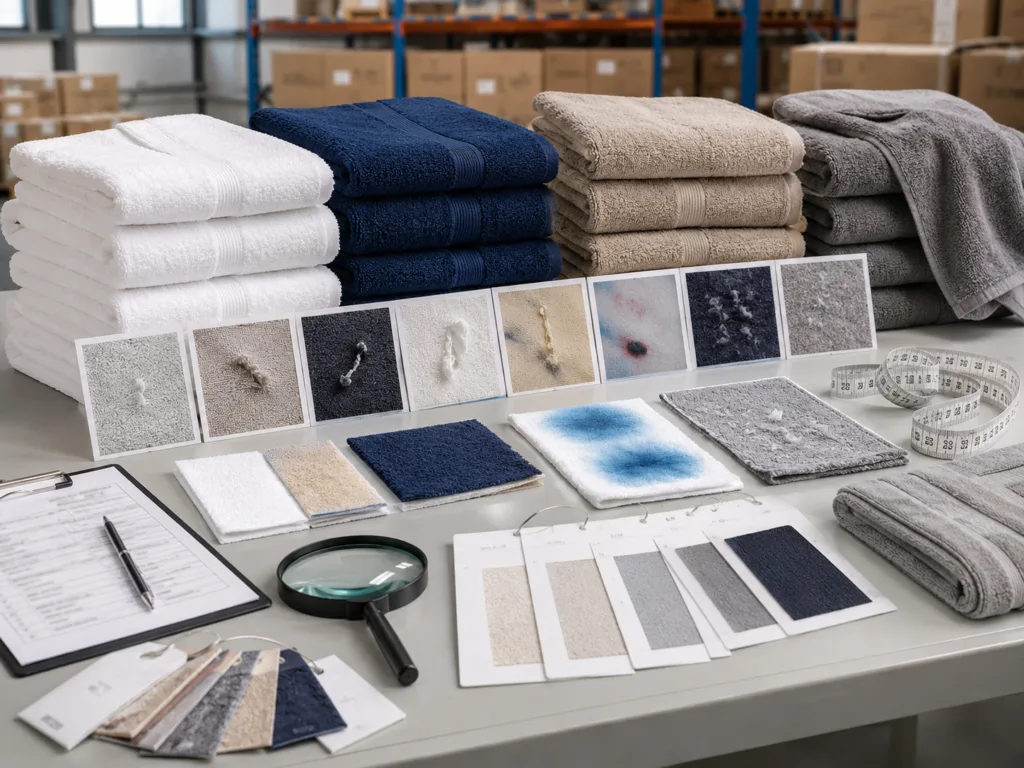
That is why common towel defects should not be treated as cosmetic problems only. For supermarkets, home textile wholesalers, hotel groups, private label brands, importers, Amazon sellers, and retail chain buyers, towel defects affect more than product appearance. They influence return rates, customer reviews, replenishment orders, brand reputation, and long-term sourcing cost.
A professional towel supplier should not simply say, “Our towels are good quality.” A reliable supplier should understand yarn selection, fabric construction, GSM, absorbency, dyeing stability, shrinkage control, sewing quality, packaging protection, and pre-shipment inspection.
This guide explains the four most common towel defects in bulk orders: shedding, color bleeding, shrinkage, and loose threads. More importantly, it explains how buyers can prevent these issues before production, during sampling, and before shipment.
Why Common Towel Defects Matter in Bulk Orders
Towels are high-contact textile products. Customers use them on the face, body, hands, hair, gym equipment, hotel bathrooms, spa rooms, beach chairs, and retail gift sets. Because towels are washed repeatedly, defects often appear after use rather than during a quick visual check.
For B2B buyers, this creates a sourcing risk.
A towel may look soft and attractive in the showroom, but after several wash cycles it may lose lint, fade, shrink, twist, or show weak stitching. That is why mature buyers evaluate towels by performance, not just by first touch.
Professional textile testing organizations commonly evaluate textiles for properties such as colorfastness, dimensional stability, appearance retention, physical performance, pilling, linting, and washing durability. Intertek lists colorfastness to washing, bleaching, dry cleaning, dimensional stability, appearance retention, strength, abrasion, pilling resistance, finish analysis, and pH among key textile testing areas. SGS also identifies color fastness, shrinkage, fiber composition, pilling, linting, and washing performance as important textile testing categories.
For towel buyers, the key question is simple:
Will this towel still look, feel, absorb, and perform correctly after repeated washing?
If the answer is uncertain, the order carries risk.
1. Towel Shedding: When Softness Becomes a Complaint
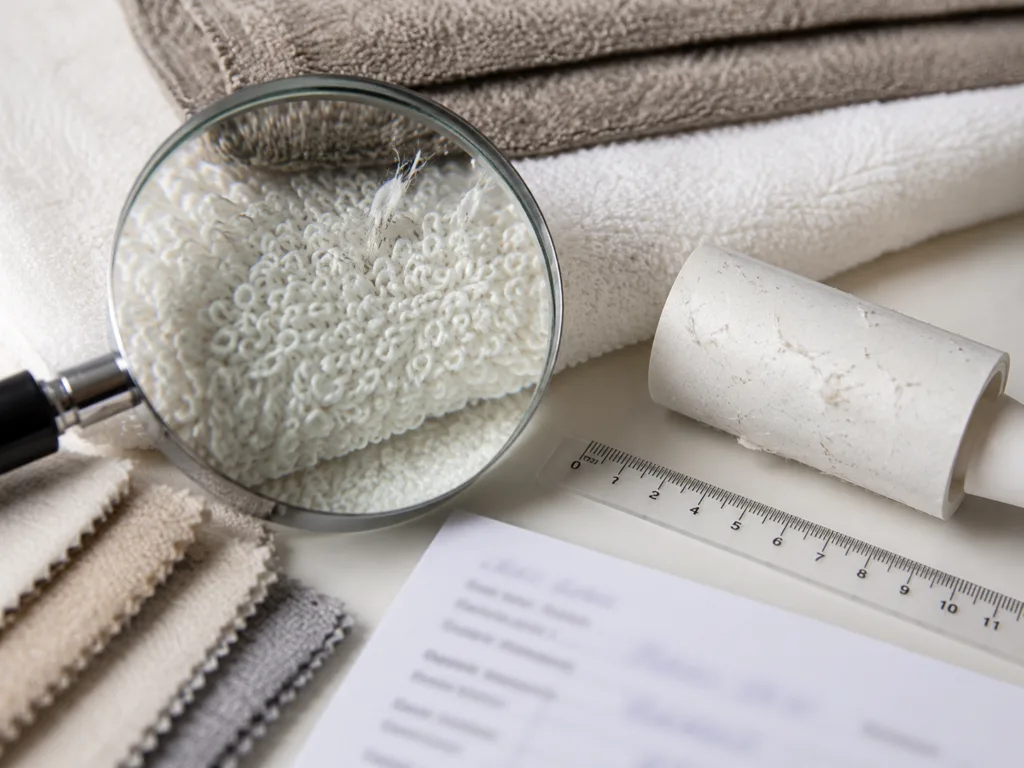
Towel shedding means loose fibers or lint come off the towel surface during use, washing, or drying. Some lint release is normal for new cotton towels, especially during the first few washes. However, excessive shedding is a quality defect.
For hotels, gyms, salons, spas, and retail brands, shedding can create several problems:
- Lint sticks to skin, hair, clothing, bathroom surfaces, or other textiles.
- Customers may think the towel is low quality.
- Dark towels may shed visible lint onto light surfaces.
- White towels may release lint during industrial laundering.
- Retail buyers may receive bad reviews after the first wash.
- Hospitality buyers may face complaints from guests.
Common Causes of Towel Shedding
Shedding is usually linked to yarn quality, terry loop structure, finishing process, and washing treatment.
Low-quality cotton fibers are more likely to break and release lint. Shorter fibers generally create more loose ends than longer, stronger fibers. If the terry loops are too loose, uneven, or poorly secured, they can release fibers more easily. Poor cutting, weak finishing, insufficient washing, or inadequate lint removal before packing can also increase shedding.
Fabric structure matters as well. A thick, fluffy towel may feel attractive in a sample room, but if the yarn strength and loop stability are weak, it may shed heavily after washing. This is why buyers should not judge towel quality by softness alone.
How GSM Affects Shedding
GSM means grams per square meter. It measures the weight of a textile fabric. In towels, GSM strongly influences hand feel, absorbency, drying time, and perceived quality.
Many cotton bath towels fall within a broad GSM range. Lower GSM towels are lighter and faster drying, while higher GSM towels feel heavier, denser, and more absorbent. NBC Select notes that 600–900 GSM towels are generally considered heavyweight and plush.
However, higher GSM does not automatically mean better quality. A 700 GSM towel made with poor yarn and weak finishing can shed more than a 500 GSM towel made with better cotton and controlled weaving. For bulk orders, buyers should evaluate GSM together with yarn quality, loop density, absorbency, drying requirements, and end-use scenario.
How to Prevent Shedding in Bulk Orders
Before placing a large towel order, buyers should request:
- Pre-production sample approval
- Washing test after several cycles
- Lint observation after washing and drying
- GSM confirmation
- Yarn and material confirmation
- Clear surface inspection before packing
- Pre-shipment inspection with defect classification
For hotel and spa towels, buyers may prefer stronger yarn, controlled loop height, durable hem stitching, and washing performance over extreme fluffiness. For retail towels, a soft hand feel is important, but it should not come at the cost of lint complaints.
2. Color Bleeding: The Defect That Can Damage More Than the Towel
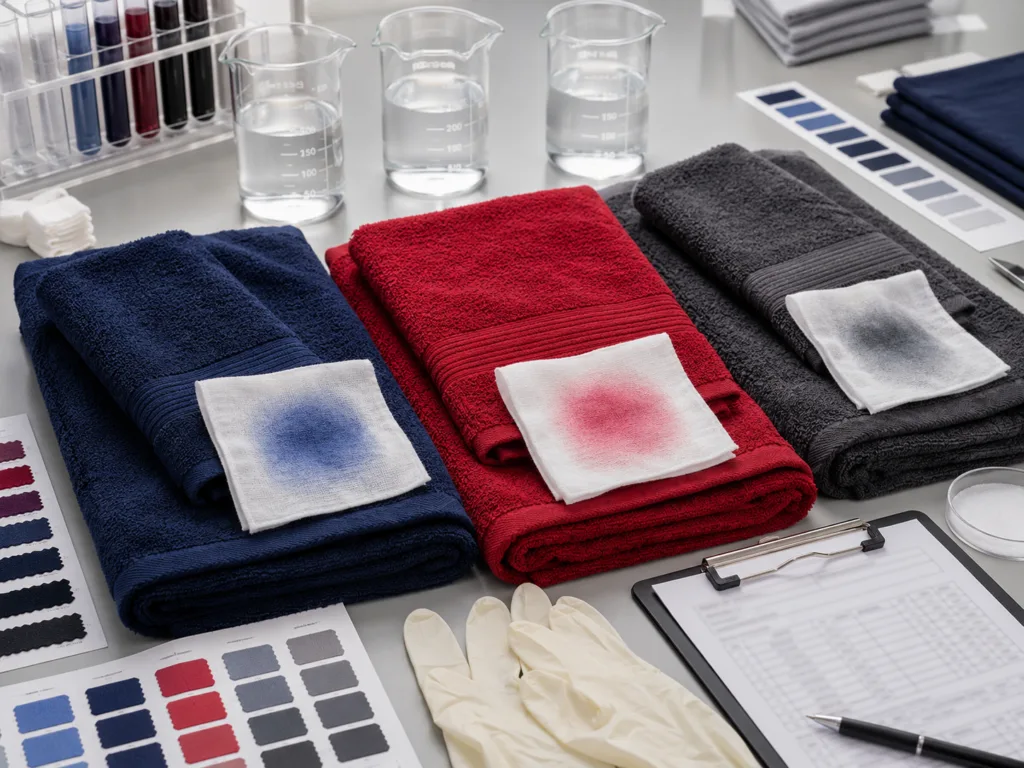
Color bleeding happens when dye transfers from a towel to water, other fabrics, skin, packaging, or washing machines. It is one of the most serious defects in bulk towel orders because it can damage other products.
For example, a navy towel that bleeds during washing may stain white hotel linens. A red promotional towel may transfer color onto customer clothing. A dark gym towel may stain a retail package insert. For Amazon and retail buyers, color bleeding can quickly become a review problem.
Why Towels Bleed Color
Color bleeding usually comes from poor dye selection, weak dye fixation, insufficient washing, poor after-treatment, or overly aggressive color requirements.
Deep colors and bright colors carry higher risk than white, beige, light grey, or pastel shades. Black, navy, burgundy, red, dark green, and high-saturation custom colors should be tested carefully before bulk production.
Colorfastness testing evaluates whether a textile resists color change or dye transfer under conditions such as washing, rubbing, light exposure, perspiration, or bleaching. Intertek describes colorfastness testing as a way to evaluate resistance to color changes or dye transfer under specific conditions. AATCC also develops textile test methods and procedures used across the textile industry.
Colorfastness Matters by Application
Different towel markets require different levels of color control.
Hotel towels
Hotels often prefer white because it can be washed at high temperature, visually signals cleanliness, and is easier to standardize across rooms. If colored hotel towels are used, the buyer should confirm washing conditions and colorfastness requirements.
Spa towels
Spa towels often use beige, charcoal, brown, sage, or muted colors. These shades look premium, but they still need good dye fixation because they are washed frequently.
Retail towels
Retail towels need strong shelf appeal. Color consistency between samples and bulk production is very important, especially for home textile sets.
Promotional towels
Bright logo colors and seasonal colors may be attractive, but they require extra attention to dyeing, embroidery, printing, and packaging contact.
Amazon and e-commerce towels
Customers often wash products immediately after receiving them. If color bleeding happens during the first wash, negative reviews may follow quickly.
How to Reduce Color Bleeding Risk
For bulk towel sourcing, buyers should confirm:
- Pantone reference or approved physical color swatch
- Lab dip approval before production
- Bulk color confirmation
- Washing colorfastness test
- Rubbing/crocking colorfastness test
- Dark and light color separation in packaging
- Care label instructions
- Whether the color is suitable for chlorine bleach or industrial washing
Buyers should also remember that color consistency can vary between dye lots. For repeat orders, it is best to keep a signed production standard sample or approved color card for comparison.
3. Shrinkage: Why “Correct Size” Must Mean After Washing
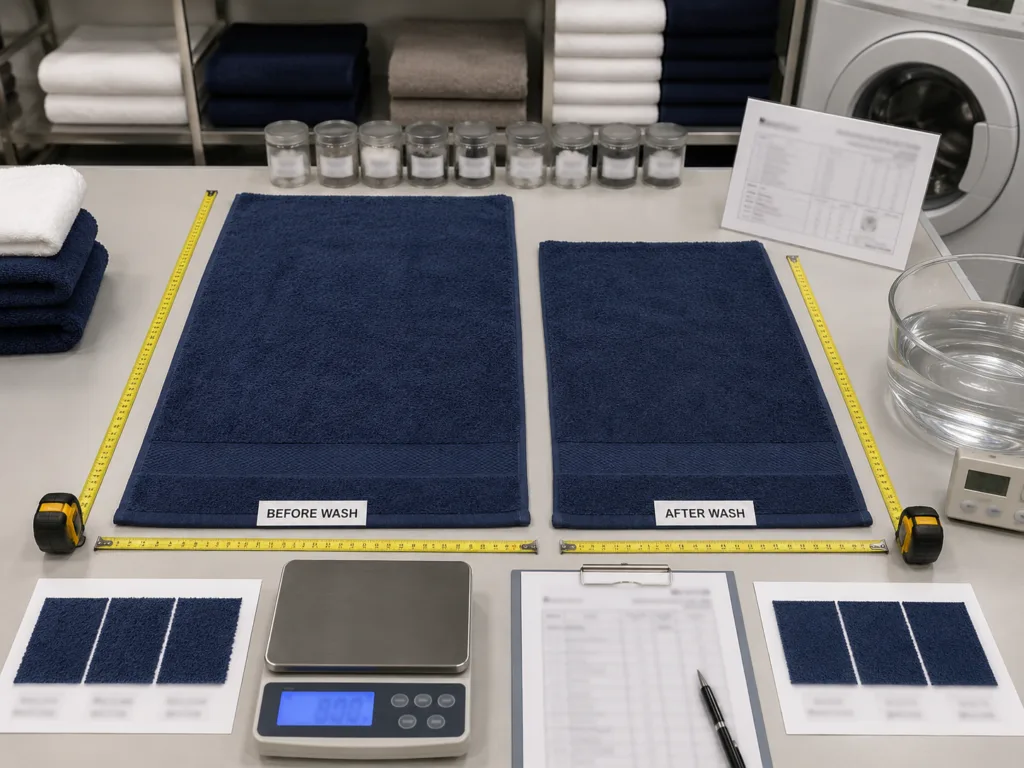
Shrinkage is one of the most misunderstood towel defects.
Cotton towels naturally change after washing. The problem is not that a towel shrinks at all. The real problem is uncontrolled shrinkage, excessive shrinkage, or shrinkage that was not discussed before production.
For example, a buyer may order a 70 × 140 cm bath towel. If the towel shrinks too much after washing, it may no longer meet hotel, retail, or packaging requirements. For towel sets, inconsistent shrinkage between face towel, hand towel, bath towel, and bath sheet can make the full set look poorly developed.
Why Towels Shrink
Shrinkage can be influenced by:
- Fiber type
- Yarn structure
- Weaving tension
- Terry loop construction
- Finishing process
- Pre-shrinking treatment
- Washing temperature
- Drying method
- Industrial laundry conditions
- Packaging compression
Cotton towels generally need shrinkage control because cotton fibers and woven structures relax after washing. Microfiber towels may behave differently, while cotton-poly blends may offer different dimensional stability depending on construction.
SGS notes that shrinkage testing helps confirm whether textile color quality, size, and shape remain stable after washing, exposure to light, or rubbing. Intertek also includes dimensional stability to washing and dry cleaning among textile performance tests.
Buyers Should Confirm Washed Size, Not Only Finished Size
A common sourcing mistake is approving only the finished size before washing.
For mature buyers, the more useful question is:
What will the towel size be after washing?
For retail, the packed size and shelf presentation matter. For hotels, washed size matters more because towels enter repeated laundry cycles. For spas and gyms, towels must remain consistent in stack size, storage, and daily use.
Shrinkage Control Checklist
Before confirming a bulk towel order, buyers should ask:
- What is the expected shrinkage rate?
- Is the size measured before or after washing?
- Has the towel been pre-shrunk?
- How many wash cycles were tested?
- What washing temperature was used?
- Was tumble drying included?
- Is this towel suitable for hotel laundry?
- Should the production size be adjusted to allow for shrinkage?
A responsible supplier will not promise “zero shrinkage.” That is usually unrealistic for cotton towels. A better supplier will explain the expected shrinkage range and help buyers design the correct production size.
4. Loose Threads: Small Defects That Signal Weak Process Control
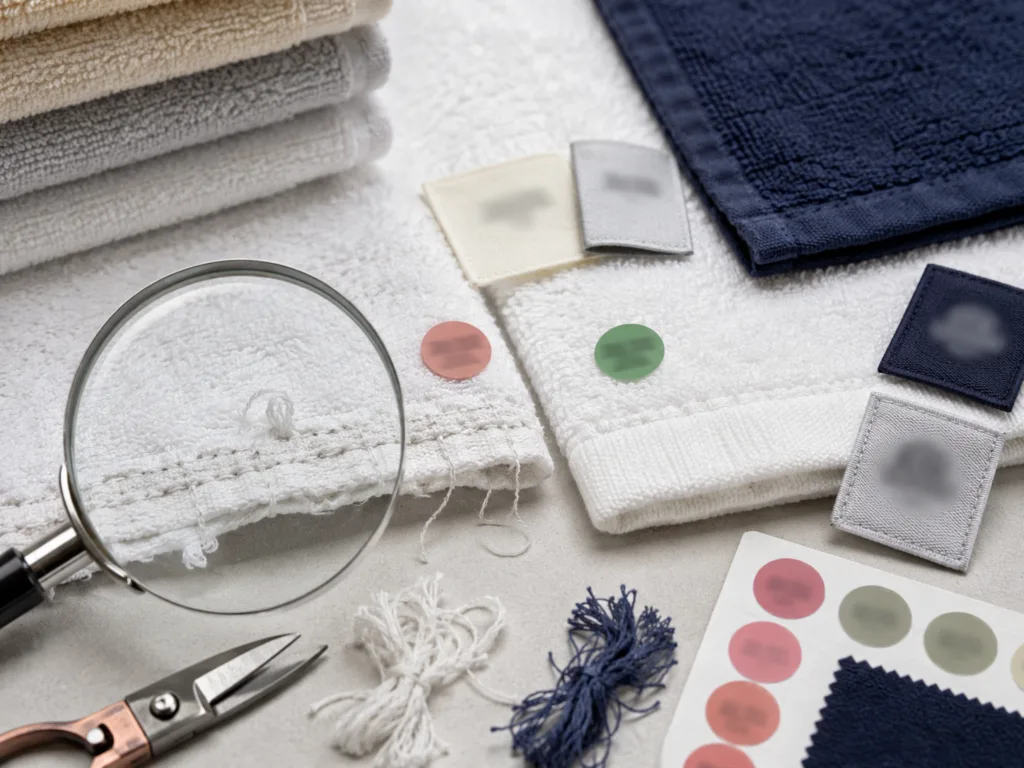
Loose threads are one of the easiest towel defects to see. They may appear on hems, borders, woven labels, embroidery areas, hanging loops, decorative trims, or cut edges.
Although loose threads may seem minor, they create a poor first impression. For retail towels, customers may see them immediately after opening the package. For hotel towels, loose stitching can become worse after repeated washing. For private label brands, visible thread problems weaken the premium image.
Common Causes of Loose Threads
Loose threads may come from:
- Poor sewing tension
- Weak hem stitching
- Unstable trimming process
- Low-quality sewing thread
- Rough handling during production
- Inadequate final inspection
- Embroidery or label attachment defects
- Poor edge finishing after cutting
In towel manufacturing, finishing details matter. Even if the terry fabric is acceptable, poor hemming can make the final product look cheap. This is especially important for gift towels, retail towel sets, hotel towels, and private label collections.
Where Buyers Should Inspect Loose Threads
During sample approval and pre-shipment inspection, buyers should check:
- Four edges of each towel
- Hem stitching
- Decorative border
- Hanging loop
- Embroidery area
- Printed logo area
- Woven label
- Care label
- Corner finishing
- Any pulled loops on the towel surface
Loose threads should be classified by severity. A small trimmed thread may be a minor defect. Open stitching, broken seams, loose labels, or long pulled loops may be major defects because they affect appearance or durability.
How to Inspect Towels Before Bulk Shipment
For large-volume towel orders, inspection should not rely only on supplier photos. A structured towel inspection plan reduces risk before the goods leave the factory.
Many product inspections use AQL sampling. ANSI/ASQ Z1.4 provides sampling plans, procedures, and acceptance levels for inspection by attributes. QIMA also describes AQL as a sampling method used to determine sample size and acceptance numbers during product inspection.
For towel orders, inspection should include both visual and functional checks.
1. Quantity and Carton Check
Inspectors should verify:
- Total quantity
- Carton quantity
- Assortment ratio
- Color ratio
- Size ratio
- Carton marks
- Barcode labels
- Shipping marks
- Packing list consistency
This is especially important for retail chain buyers and importers who need accurate warehouse receiving.
2. Size and Weight Check
Towels should be measured and weighed against approved specifications.
Check:
- Length
- Width
- GSM
- Weight per piece
- Weight per dozen if required
- Tolerance range
- Washed size if specified
For hotel buyers, GSM and size directly affect product feel, laundry cost, storage space, and guest experience.
3. Appearance Inspection
Visual inspection should cover:
- Shedding
- Color difference
- Stains
- Oil marks
- Dirty spots
- Pulled loops
- Loose threads
- Uneven stitching
- Skewed borders
- Poor folding
- Label mistakes
- Packaging defects
4. Absorbency Check
Absorbency is one of the most important towel performance factors. A towel can look thick but still absorb poorly if finishing chemicals, softeners, or fiber structure interfere with water absorption.
Buyers should consider:
- Water absorption speed
- Water holding capacity
- Hand feel after washing
- Whether the towel has excessive softener
- Whether the towel is suitable for hotel, gym, spa, or retail use
For gym towels and quick-dry towels, buyers may prioritize faster drying. For luxury bath towels, buyers may prioritize softness and absorbency. For hotel towels, buyers usually need a balance between durability, washing performance, absorbency, and cost.
5. Packaging Inspection
Packaging is not just presentation. It protects the product during export.
Check:
- Individual polybag quality
- Paper belly band position
- Hang tag accuracy
- Retail box structure
- Gift box protection
- Carton strength
- Carton dividers if needed
- Moisture protection
- Compression level
- Barcode readability
- Mixed-color packing separation
For e-commerce and retail buyers, packaging affects customer experience. For importers and wholesalers, packaging affects warehouse handling, barcode scanning, and damage rate.
Choosing the Right Towel by Application
Different buyers need different towel specifications. There is no single “best towel” for every market.
Hotel Towels
Hotel towels need durability, stable whiteness, strong stitching, good absorbency, and controlled shrinkage. They are washed frequently, often under more demanding laundry conditions than home towels. Buyers should focus on long-term performance rather than only softness.
Recommended focus:
- Durable cotton construction
- Controlled GSM
- Strong hems
- Good absorbency
- Low linting
- Shrinkage control
- Industrial laundry suitability
Retail and Home Textile Towels
Retail towels need attractive colors, soft hand feel, consistent sizing, clean finishing, and good shelf presentation. Packaging and color matching are more important than in plain institutional towels.
Recommended focus:
- Color consistency
- Soft touch
- Premium folding
- Hang tags or belly bands
- Private label packaging
- Low loose-thread rate
- Clear care label
Spa and Salon Towels
Spa towels need a premium look, soft touch, absorbency, and frequent washing durability. Muted colors are common, but colorfastness still matters.
Recommended focus:
- Soft cotton or blend
- Elegant colors
- Good dye fixation
- Durable stitching
- Comfortable skin contact
- OEKO-TEX options if needed
OEKO-TEX STANDARD 100 is a widely recognized label for textiles tested for harmful substances, covering materials from yarn to finished products.
Gym and Fitness Towels
Gym towels need quick drying, compact size, sweat absorption, and repeated washing performance. Microfiber, cotton, and cotton-blend options may all work depending on the product positioning.
Recommended focus:
- Fast drying
- Lightweight GSM
- Strong edge stitching
- Good absorbency
- Low lint
- Bulk packing efficiency
Gift and Promotional Towels
Gift towels need clean presentation, attractive packaging, and stable logo customization. Loose threads, stains, poor folding, or bad packaging can ruin the perceived value.
Recommended focus:
- Clean trimming
- Embroidery or logo accuracy
- Gift box or paper sleeve
- Color consistency
- Good folding
- Retail-ready packaging
How to Avoid Bulk Towel Quality Problems Before Production
The best time to solve towel defects is before production starts.
A mature supplier should help buyers confirm the product specification clearly, not rush into production with vague requirements.
Before placing a bulk towel order, buyers should confirm:
- Material: cotton, bamboo, microfiber, cotton blend, or custom fiber blend
- Yarn type and quality level
- GSM
- Finished size and washed size
- Color standard
- Logo method: embroidery, woven label, printing, jacquard, or hang tag
- Edge finishing
- Absorbency requirement
- Shrinkage tolerance
- Colorfastness requirement
- Packaging method
- Carton packing quantity
- Inspection standard
- Delivery schedule
- Export documents
For private label towel projects, a supplier should also support sample development, color matching, packaging design, barcode requirements, carton marks, and export-ready packing.
Why a Reliable Towel Supplier Matters More Than the Lowest Price
In towel sourcing, the lowest unit price is not always the lowest total cost.
A cheaper towel may create higher risk if it sheds, bleeds color, shrinks too much, or arrives with loose threads. Once the goods are shipped overseas, solving quality problems becomes expensive. Returns, discounts, customer complaints, repacking, replacement shipments, and damaged buyer relationships can cost far more than the original price difference.
A reliable towel supplier helps buyers reduce these risks by controlling:
- Material selection
- Dyeing process
- GSM accuracy
- Cutting and sewing quality
- Washing performance
- Shrinkage range
- Colorfastness
- Packaging protection
- Pre-shipment inspection
- Export documentation
For large supermarkets, home stores, hotel groups, importers, Amazon sellers, and private label brands, supplier reliability is not a soft advantage. It is a commercial necessity.
The right supplier should help you prevent problems before they become claims.
Final Thoughts
Common towel defects such as shedding, color bleeding, shrinkage, and loose threads can seriously affect bulk towel orders. These issues are not only production problems; they are business risks for brands, retailers, hotels, wholesalers, and importers.
A good towel should not only look soft in a sample photo. It should perform after washing, maintain its size within an acceptable range, hold its color, absorb well, resist excessive lint, and arrive in clean, export-ready packaging.
If you are sourcing wholesale towels for hotels, supermarkets, home stores, spas, Amazon, retail channels, or private label projects, work with a supplier who understands both production details and buyer-side risk control. From material selection and GSM confirmation to color testing, shrinkage control, packaging development, and pre-shipment inspection, the right partner can help you build a more stable towel supply chain and reduce costly after-sales problems.
FAQ
1. What are the most common towel defects in bulk orders?
The most common towel defects include shedding, color bleeding, shrinkage, loose threads, stains, pulled loops, uneven stitching, color difference, poor absorbency, and packaging damage. Among these, shedding, color bleeding, shrinkage, and loose threads are especially important because they often appear after washing or customer use.
2. How can buyers prevent towel shedding?
Buyers can reduce towel shedding by choosing better yarn quality, suitable GSM, stable terry construction, proper finishing, and pre-shipment inspection. Washing tests before bulk production are also important, especially for hotel towels, dark towels, and premium retail towels.
3. Why do towels bleed color after washing?
Towels may bleed color because of poor dye fixation, weak dyeing control, insufficient washing after dyeing, or unsuitable dye selection. Deep and bright colors usually carry higher risk, so buyers should request colorfastness testing and approve lab dips before bulk production.
4. What should be checked during towel inspection before shipment?
A towel inspection should check quantity, size, GSM, weight, color consistency, stains, shedding, loose threads, pulled loops, stitching quality, absorbency, shrinkage, labels, packaging, carton marks, barcode labels, and export carton condition. For large orders, buyers can use AQL sampling or third-party inspection before shipment.