
Introduction to Certifications and Compliance in the Towel Industry
For brands sourcing towels under their own label, understanding private label towels certifications, gots certified towels, organic towel, oeko-tex towels is critical. Certifications aren’t just badges; they’re signals of product safety, sustainability, and legal compliance that drive consumer trust and enable smooth market entry.
In the textile industry, compliance requirements impact reputation and determine whether towels can be sold in key markets. Whether it’s ensuring chemical safety, meeting environmental standards, or attaching proper material labels, brands face strict rules that shape their sourcing decisions.
Consumers increasingly expect organic towel options and oeko-tex towels—labels that assure them the textiles are non-toxic and responsibly produced. Regulations like the EU’s REACH, the US CPSIA, and retail chain policies mean towels must pass safety tests and carry valid certification marks. This influences not only the choice of supplier but also how quickly a product arrives on store shelves.
Key certifications such as GOTS and Oeko-Tex are central, but each buyer must also weigh what fits their specific business and geographic targets. Sourcing teams must understand how compliance can affect negotiations, packaging planning, and the timeline for launching new products.
Key Certifications for Private Label Towels
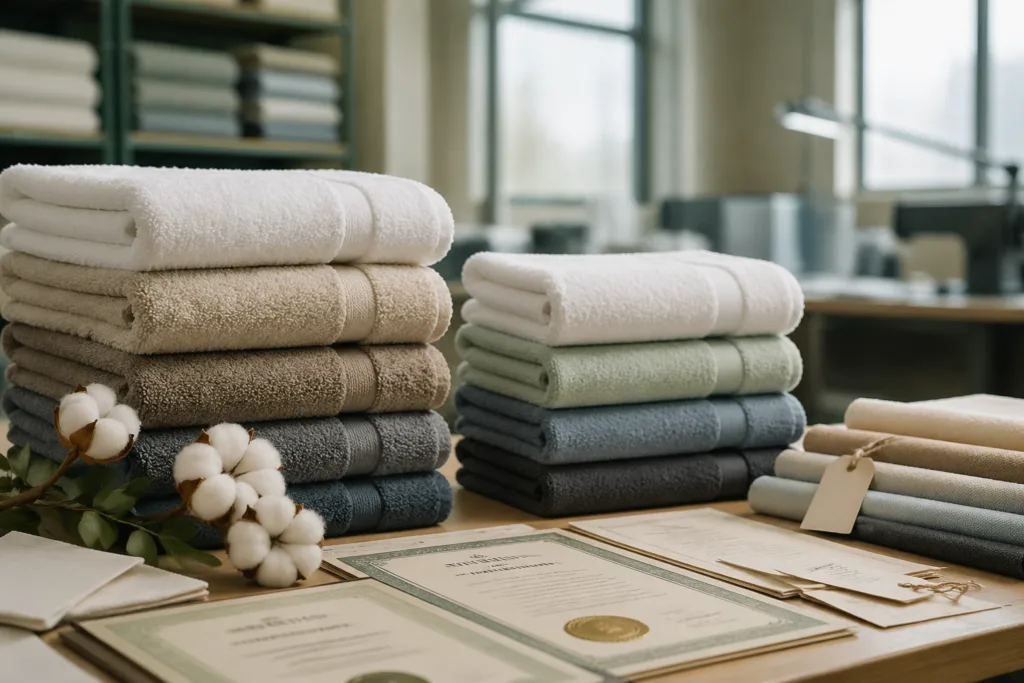
Private label towels certifications shape how brands select factories, develop product specs, and decide on timelines. Among the most authoritative, gots certified towels stand out. The Global Organic Textile Standard (GOTS) ensures that organic cotton towels are not only grown without harmful chemicals but processed under strict environmental and social criteria.
For a towel to be labeled as GOTS certified, the entire supply chain must comply. This means audits at the cotton farm, spinning mill, fabric manufacturer, and finishing stage. GOTS also enforces traceability and prohibits certain dyes, so factories must be open to transparent practices and adjust their production schedules for certification audits.
Oeko-Tex towels come with Standard 100 by Oeko-Tex, certifying that the finished product—whether cotton, microfiber, or bamboo—has been independently tested for over 100 toxic substances. This certification is recognized globally, streamlines customs clearance, and reassures retailers and consumers alike.
ISO 9001 focuses on factory quality management, while USDA Organic is significant for US retail markets with natural product categories. Other certifications, such as BSCI (for ethical sourcing), may be required by major retailers.
- GOTS: Full supply chain organic compliance.
- Oeko-Tex: Chemical safety for finished textiles.
- ISO 9001: Factory quality system standard.
- USDA Organic: Native market requirements for the US.
- BSCI: Social and ethical factory practices.
Certifications can slow production due to testing, audits, and document gathering. Some certifications are mandatory for market entry in Europe or North America. Others can be value-added, helping brands command higher prices and enter eco-conscious niches. Maintaining certification status requires regular audits; lapses may risk rejected shipments and retail delisting.
Need guidance on which certifications apply to your private label project? Circe Towel is here to help simplify the process.
Material Comparisons: Choosing the Right Fabric
The fabric choice is central to private label towels certifications and meeting market demands. Buyers often compare cotton, microfiber, and bamboo materials, each with distinct properties and compliance implications.
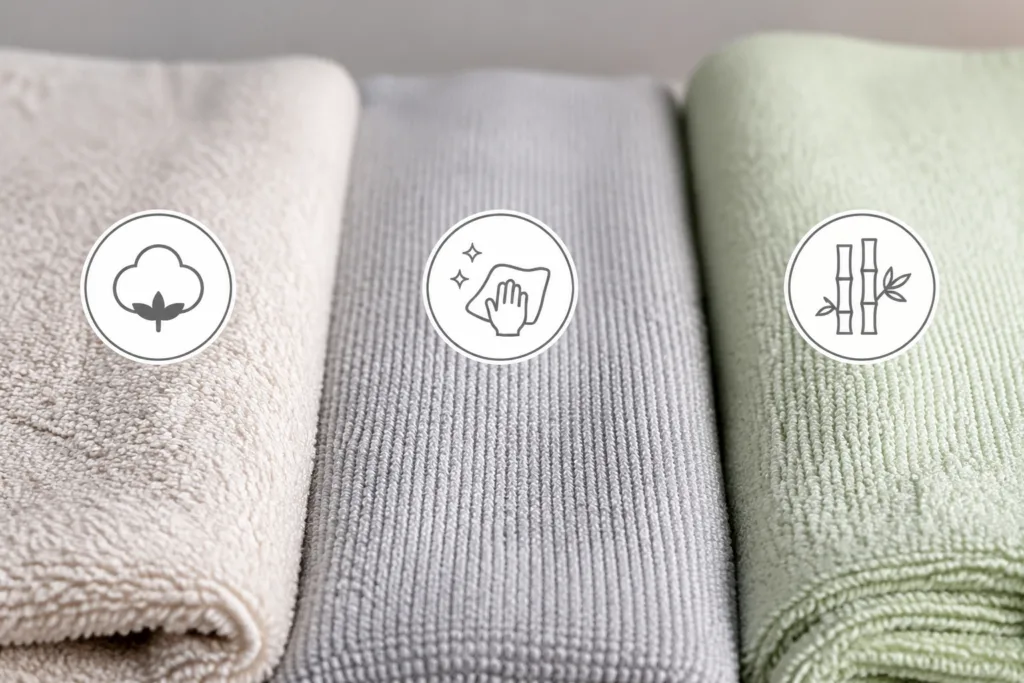
Cotton towels are valued for their absorbency and softness. Choosing organic cotton is essential for organic towel and gots certified towels claims. Microfiber towels, popular for sports and cleaning, offer fast drying and durability, yet the synthetic fiber composition limits them to Oeko-Tex certification rather than GOTS.
Bamboo and bamboo blends are increasingly requested for eco and luxury lines. While bamboo fibers can be soft and antibacterial, most are chemically processed and may not fit organic towel claims unless certified properly.
Blended fabrics (e.g., cotton-polyester) reduce costs and improve certain performance metrics, but blends may complicate compliance with certifications like GOTS and Oeko-Tex. Blends may require additional testing for chemical content and colorfastness.
The material choice also influences the quality and price point. Cotton—especially long-staple or Turkish varieties—delivers premium softness and plushness, while microfiber towels suit budget, quick-drying, and sports applications.
| Material | Key Properties | Certifications Possible | Suitable Use Cases |
|---|---|---|---|
| Cotton (organic) | Absorbent, soft, durable | GOTS, Oeko-Tex, USDA Organic | Luxury, hotel, retail, wellness |
| Cotton (standard) | Absorbent, soft, versatile | Oeko-Tex | Hospitality, retail, sports |
| Microfiber | Quick-dry, durable, lightweight | Oeko-Tex | Gym, sports, car care, budget |
| Bamboo (viscose) | Antibacterial, soft, eco appeal | Oeko-Tex (sometimes) | Luxury, spa, sustainability lines |
| Cotton blends | Cost-effective, improved elasticity | Oeko-Tex (usually), not GOTS | Promotional, budget |
Buyers can optimize towels for luxury by prioritizing organic materials, higher GSM (grams per square meter), and compliance with gots certified towels. For budget or promotional needs, microfiber and blends may suffice, as long as Oeko-Tex towels are verified for safety. Leading manufacturers like Circe Towel can advise on material sourcing aligned with certification and target market needs.
Construction and Manufacturing: Methods that Matter
Towel construction—how fibers are woven, finished, and decorated—affects compliance and performance. Four key textile constructions stand out:
- Terry: Loop-pile weave, maximizes absorbency, ideal for bath and hospitality towels.
- Velour: Sheared surface for softness and lustrous appearance, best for spa or high-end retail.
- Waffle: Textured, lighter weight, dries quickly, often used for kitchen and gym.
- Jacquard: Patterns woven directly for durability and branding, premium custom applications.
Factories must match production methods to certification requirements. Organic towel production for gots certified towels, for example, prohibits the use of unauthorized finishing chemicals and requires traceable organic inputs during weaving and dyeing.
Decoration methods influence compliance and market perception. Embroidery, digital printing, and reactive dye printing each respond differently to certification standards:
- Embroidery: Must use certified threads for GOTS/Oeko-Tex compliance.
- Printing: Digital/Reactive printing is preferred for vibrant, colorfast results but must use certified inks.
- Jacquard: Weaving logos/patterns avoids added chemicals from dyes, favoring certification needs.
Industry-wide, buyers weigh the softness, weight, and durability of different constructions. A hotel chain may prioritize terry cotton for plushness, while a sports brand opts for quick-dry waffle microfiber. The cost and compliance risks with each method can influence product design and sourcing decisions.
Circe Towel offers practical guidance on balancing these factors, advising brands on selecting constructions that meet both performance and certification requirements without compromising production stability or pricing.
Design & Spec Checklist for Private Label Towels
Sourcing teams must follow a clear checklist to ensure private label towels certifications are met and specs align with consumer expectations. Missteps here can lead to failed audits, delayed shipments, or mismatched quality.
- Size: Choose according to use—bath, hand, face, gym, golf, beach.
- GSM: Higher GSM yields plusher towels; lower GSM speeds drying (trade-off).
- Material choice: Organic cotton for GOTS, microfiber for budget, blends for promotional uses.
- Edge finishing: Double stitching and safe hem treatments improve durability.
- Logo method: Embroidery, jacquard, or certified printing; check compatibility with certification.
- Absorbency: Key for consumer satisfaction; test for market fit.
- Softness: Luxury markets demand higher standards here.
- Colorfastness: Essential for retail and hospitality; test against market-specific standards.
- Packaging: Must comply with certification requirements (e.g., recycled or organic packaging for GOTS).
Pitfalls include using uncertified dyes, neglecting colorfastness, or choosing a decorative method that isn’t compatible with the chosen certification. Before finalizing a factory or order, review the checklist and confirm each spec aligns with documentation for private label towels certifications.
| Spec Item | Compliance Impact | Market Fit |
|---|---|---|
| Size | Must match labeling regulations | Hospitality vs retail |
| GSM | Affects performance tests | Luxury vs budget |
| Material | Certification eligibility (GOTS, Oeko-Tex) | Sustainability claims |
| Edge finishing | Durability/performance audits | Hotel/retail appearance |
| Logo method | Must use certified threads/inks | Branding visibility |
| Packaging | Certification documentation | Retail ready |
Quality & Testing Standards: Ensuring Excellence
Certifications don’t guarantee performance; actual quality testing is just as important for towels. Factories and buyers must conduct thorough lab tests to ensure towels meet both consumer and compliance requirements.
Key tests include:
- Absorbency: Measured in seconds or grams, crucial for bath and sports towels.
- Wash durability: Ensures towels maintain shape and softness after repeated laundry cycles.
- Shrinkage: Typically required to be below a certain percentage; varies by market.
- Colorfastness: Checks for resistance to fading, especially important for printed or dyed items.
Quality control is a parallel process to certification compliance. Even oeko-tex towels or gots certified towels can fail if absorbency or color stability isn’t up to par. Brands occasionally face setbacks, such as a batch failing shrinkage or colorfastness, resulting in costly relabeling or loss of retail placement.
Testing failures often occur during pre-production sample reviews. For example, towels produced with incorrect GSM may fail absorbency tests, or incompatible ink used for logo printing may cause color migration post-wash. Vigilant buyers audit suppliers for robust quality assurance systems.
For more insights on quality testing and supplier audit strategies, see Circe Towel’s practical guide: Towel Quality Testing: What Brands Check Before Shipping and Expert Guide: Auditing Your Towel Supplier for Quality B2B Orders.
Industry Applications: Tailoring Towels to Fit
Private label towels serve many industries, from hospitality and retail to sports and promotional markets. Each sector has its own certification needs and consumer expectations.
Hospitality buyers must prioritize plushness, durability, and bulk production stability. Here, organic towel and gots certified towels can differentiate premium offerings, while colorfastness is vital for consistent appearance in hotels and spas.
Retail brands often require oeko-tex towels to ensure their goods are safe for all consumers, including children. Promotional segments may prioritize quick-dry properties and cost-effective materials but must still respect labeling and chemical safety regulations.
Certification requirements adapt based on sector. For example, a golf towel for tournaments needs rapid drying and robust edge finishing; an OEM spa towel needs organic certification for market positioning. Brand success stories show that compliance can unlock new retail platforms and international markets.
Consumer expectations change: luxury buyers demand softness and environmental safety, sports buyers want durability and quick-drying, and promotional markets are sensitive to cost and lead time. Product offerings must align with industry standards—see Difference Between Bath Towels, Hand Towels, and Face Towels (Manufacturing Perspective) for detailed use case insights.
Customization Options and Their Compliance Implications
Customizing towels—adding logos, patterns, borders, or packaging—creates brand differentiation but also brings compliance challenges. Each customization method must be compatible with private label towels certifications and market requirements.
Logo embroidery requires certified embroidery threads for GOTS or Oeko-Tex compliance. Jacquard weaving inserts branding directly into the fabric, simplifying compliance and providing long-term durability. Printed logos and graphics demand certified inks—especially for organic towel claims.
Labels and packaging also influence perception and compliance. Private label brands must ensure all tags, hangers, and retail packaging meet certification documentation—and that packaging aligns with recycled or sustainable claims, if applicable.
Balancing customization and operational efficiency is key. Too many custom features inflate cost and lead time but may not add proportional value. Circe Towel helps buyers prioritize customization options that fit market preferences while conforming to certification rules.
Common Mistakes and Troubleshooting in Towel Sourcing
Sourcing towels isn’t without pitfalls. Common mistakes include selecting the wrong GSM (either too thin for consumer use or too thick for bulk laundering), poor fabric choices (unapproved blends for organic certification), and failing to specify colorfastness requirements. Fading, linting, and rough hand feel negatively impact marketability.
Assessing absorbency and durability before production guards against later complaints. Weak absorbency or a scratchy texture signals poor quality, leading to negative consumer feedback and potential returns.
Ignoring stitching quality may result in fraying or loss of branding, while choices in logo decoration that aren’t compatible with certification risk shipment rejection. Preemptive solutions include robust sample testing, regular supplier audits, and clear communication of compliance and performance standards.
For more actionable sourcing guidance, refer to: Your Step-by-Step Factory & Brand Launch Checklist: Towel Sourcing Made Simple and 20 Must-Ask Questions for Smooth Towel Sourcing: From Samples to Shipping and Restocking.
Ordering Guide: Navigating the Procurement Process
Ordering private label towels successfully demands structured planning. Minimum order quantities (MOQ) and lead times shift depending on certification requirements; GOTS or Oeko-Tex audits can extend timelines.
Artwork preparation and proofing should factor in decoration methods; embroidery or jacquard need vector files and thread Pantone codes, while digital printing demands colorfast ink compatibility. Packaging must meet certification standards and market presentation norms.
Shipping considerations include compliance documentation for each region (e.g., Europe, US), and some certification marks must be visible on packaging or customs paperwork. Sample requests and final orders benefit from a planned timeline—prototyping, testing, and auditing may take weeks to months before bulk production.
For additional detail on MOQ, sampling, and manufacturing lead times, see Private Label Towels: Your Complete Guide to MOQ and Cost Structure and Complete Guide to Towel Manufacturing: MOQ, Sampling, Quality, and Lead Time Explained.
Frequently Asked Questions
What certifications do I need for private label towels?
The main certifications are GOTS for organic cotton towels and Oeko-Tex Standard 100 for chemical safety. Others like ISO 9001 or USDA Organic may be required by specific markets or retailers.
How do I ensure my towels meet compliance standards?
Work with certified suppliers, review lab test reports, and audit production processes. Make sure every material and decoration method used aligns with chosen certification requirements.
Can I customize my towels without losing certification?
Yes, but each custom feature—logo thread, print ink, packaging—must be certified and documented. Reach out to suppliers experienced in customization and compliance.
What materials are best for GOTS certified towels?
Organic cotton is required for GOTS certified towels. All supply chain steps, including spinning, weaving, and finishing, must follow GOTS guidelines.
How do testing requirements differ by market?
Testing standards vary—Europe emphasizes chemical and environmental safety, while the US focuses on labeling and durability. Retail chains often add their own requirements.
What are the costs associated with certifications?
Certification costs include audit fees, laboratory testing, and ongoing renewal. These may increase production prices but help build trust and market access.
Summary and Closing Thoughts
Sourcing private label towels requires a strategic approach—aligning product specs, material selection, and decoration methods with market certifications and compliance rules.
GOTS certified towels, oeko-tex towels, and organic towel claims build trust with buyers, but real-world success depends on supplier reliability and robust testing. Buyers should audit their suppliers, review documentation, and plan for certification lead times.
Careful preparation pays off: compliant towels enter retail faster, enjoy consumer trust, and face fewer post-launch issues. Buyers are encouraged to stay proactive, ask the right questions, and keep compliance at the core of their sourcing decisions.
If you’re looking for compliant, high-quality private label towels that meet your specific needs, request a sample from Circe Towel today.
Related Reading
- Build a Profitable Private Label Bath Towel Line – Sourcing Strategies and Material Tips
- Create Custom Towels with Logo: Design and Buying Essentials for Your Brand
- Master Custom Printing – How to Specify and Order Printed Towels for Your Brand
- Why Choose Embroidered Towels? Expert Advice for High-End Branding Methods
- Understanding MOQ & Costs for Private Label Towels – Avoid Common Ordering Mistakes
- What Brands Check Before Shipping: Towel Quality Testing Made Simple